
If you’ve battled a slice, watching your ball curve hard right (for right-handed players) time and again—you’re not alone. It’s one of the most common swing flaws in golf, and it can be both frustrating and difficult to fix without a clear understanding of what’s actually going wrong in your motion.
Thankfully, with today’s technology, you no longer need to rely solely on feel or guesswork. Motion analysis through video tools like Onform gives you a deeper, measurable look at how your body is moving in the swing. Instead of watching from just one angle, you’re now able to visualize rotation, sequencing, and club position in a way that highlights the root of the problem.
Why Slices Happen—and What 3D Reveals
A slice typically results from a combination of an open clubface and an over-the-top, outside-in swing path. But those symptoms are often caused by deeper movement flaws that start long before impact. Two of common causes we can clearly see in 3D video analysis include:
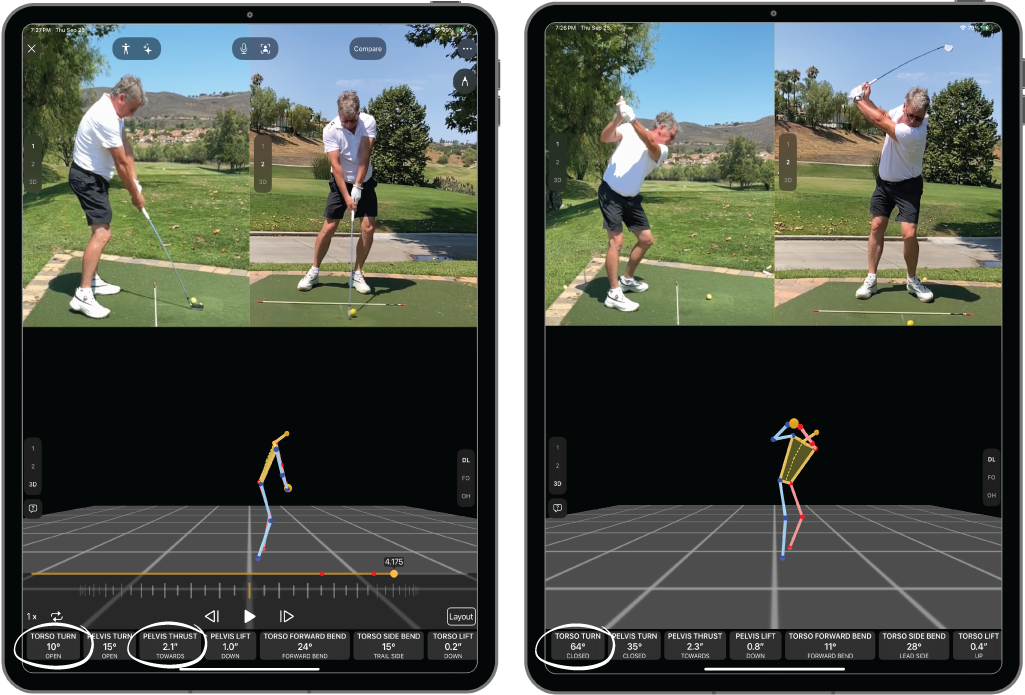
1. Early Hip Extension
When the pelvis thrusts toward the ball during the downswing, it can reduce space for the arms and limit proper torso rotation. This forces the club to steepen and can influence an outside-in path, contributing directly to a slice.
What we see in 3D:
- Pelvis thrust toward target line: more than 2 inches from address to impact
- Torso rotation stalls at impact: less than 15° open
- Sequence breakdown: ips peak early, and toros doesn’t catch up don’t catch up
Correction focus: Improve lower body stability, train the hips to rotate rather than thrust, and time rotation sequencing to maintain space for the arms and club.
2. Inadequate Torso Rotation in the Backswing
A lack of upper body rotation prevents the club from getting deep enough behind the player. As a result, in transition, the arms lift and move over the top, throwing the club outside and steep.d steep.
What we see in 3D:
- Torso rotation at top of backswing: <65° from address (ideal range: 85 plus–°)
- Torso-hip separation: <40° (we want a 2:1, or close to, for proper coil)
- Shallowing never happens: club path remains steep and outside
Correction focus: Improve thoracic mobility, rehearse deeper turns with tools like alignment rods across the chest, and train sequencing to allow the arms to drop rather than lift.
The Power of Measurable Feedback
Onform’s 3D overlay features allow us to analyze your motion from any angle and track movement patterns across sessions. We can draw lines, measure degrees of rotation, and overlay swings to track improvement over time. This isn’t about guessing what might be wrong, it’s about using visual proof and objective data to build a more functional and repeatable swing.
One of the biggest mistakes golfers make when trying to fix a slice is working on the wrong part of the swing. If you only focus on clubface or grip without addressing how your body moves, the problem often comes back. With 3D video analysis, you can direct your practice time toward the exact movement patterns that need work, whether that’s a better backswing coil, improved transition, or more connected arm movement through impact.
While slices are a frequent concern, the insights gained from 3D video analysis also help correct:
- Hooks from early release or flipped wrists
- Loss of power from poor body sequencing
- Sway or slide during setup and backswing
- Tempo and rhythm inconsistencies
Fixing your slice isn’t only about changing your grip or hoping your path straightens out. It’s about identifying why the club is getting out of position and where your body is contributing to the flaw. Using 3D video analysis through Onform, we can break down your motion with clarity, track your progress, and implement movement corrections that actually stick.
Your straighter, more controlled ball flight is only a frame-by-frame analysis away.

Dr. Alison Curdt is a PGA Master Professional in Instruction, an LPGA Master Professional, and a Golf Digest Top 50 Teacher in America. She was one of only nine women to achieve the highest PGA credential earned by an instructor and one of just two women to be a dual Master Professional in both organizations. With over two decades of coaching experience, Dr. Alison combines her expertise in golf instruction with a unique approach rooted in sports psychology, helping players improve both their physical and mental games. She holds a Doctorate in Clinical Psychology and specializes in integrating mental performance strategies to enhance her students’ on-course success. Dr. Alison is a speaker, mentor, and advocate for women in golf, dedicated to growing the game and empowering players of all levels.