
Editor’s Note: This is Part 1 of a three-part series highlighting the commitment and time restraints many coaches face with their mid- to high-handicap students. Erik Schjolberg, the founder and head coach at EJS Golf in Scottsdale, Arizona, has coached a diverse range of golfers — from PGA Tour players and college athletes to everyday amateurs. In this article, Erik explains how just one hour with a student, paired with the right teaching tools, can lead to a noticeable difference in performance.
In golf instruction, an elite coach will identify a golfer’s swing fault, explain and demonstrate the fix, observe the student working on the fix via drills, and show the measured improvement via video and data all in one hour’s time.
I view one hour as a challenge in that I find it imperative that the student improves during this time. I don’t teach with tips, vague feels or long timelines. I have to identify the biggest limiter, solve it efficiently, and leave the student with a plan they can execute when they are on their own.
Hi, I’m Coach Erik Schjolberg of EJS Golf – The Science of Better Golf. I teach out of McCormick Ranch in Scottsdale, Arizona. I use the Onform app for diagnosis, feedback and follow-through. TrackMan can tell me what the ball is doing. Onform helps me prove why the body is producing that result, and it lets me communicate the fix during and after the lesson.
“TrackMan can tell me what the ball is doing. Onform helps me prove why the body is producing that result, and it lets me communicate the fix during and after the lesson.”
Ball Striking Machine: Low-Point Control
The best metric to evaluate the difference between skill levels isn’t a prettier backswing or a textbook-looking finish, it’s low-point control. Low point is measured where the club bottoms out relative to the golf ball.
Elite players live in a tight window. Amateurs don’t. That gap is the source of the three scorecard killers: fat shots, thin shots and topped shots. When low point is inconsistent, contact becomes random, distance becomes unreliable, and the golfer starts making compensations that create even more variability.
My objective in most golf lessons is to engineer the ball first, then turf contact. For the golfer that has figured this part out, we dial in proximity, dispersion, etc. I’m not chasing positions for aesthetics. I’m building impact conditions — forward shaft lean, a stable pivot, and a predictable bottom of the arc that lives in front of the ball.
When low point moves forward and stays there, compression stops being a “talent” and becomes a predictable outcome.
Biomechanical Diagnosis with Onform
The fastest way to improve in one hour is to stop guessing. Onform matters because it takes video from “I think” to “I can prove.” Launch monitors are excellent at describing performance — club delivery, face-to-path, angle of attack, dynamic loft.
But when a golfer is struggling with strike, the root cause is usually a body problem: how the pelvis is moving, how pressure is shifting, and whether the golfer is maintaining space and posture through impact. That’s where Onform earns its place in my coaching.
Using Onform’s AI-driven body tracking, I can quantify movement patterns that directly influence low point.
“The fastest way to improve in one hour is to stop guessing. Onform matters because it takes video from ‘I think’ to ‘I can prove.”
Two of the most common silent killers are sway and thrust (early extension). Excessive sway — especially swaying off the ball in the backswing and failing to return — changes where the swing arc bottoms out.
If a golfer moves several inches away from the target and doesn’t fully recenter, fat contact and tops become a mathematical certainty because the bottom of the arc is no longer reliably forward of the ball.
Thrust, or early extension, is another major culprit. When the hips thrust towards the ball either in the backswing, downswing or both, and posture is lost, the golfer runs out of room. The hands and arms have to save it, which usually shows up as a flip, cast, or handle stall. When that happens, low point control becomes nearly impossible.
Onform allows me to show the student exactly what their body is doing, not just tell them what it feels like. And that clarity is what accelerates change.
Drills to Improve Low-Point Control
Once I identify the biomechanical issue(s), I don’t waste time. I go straight to drills that reorganize impact and force the low point to move forward.
The goal is not to practice more. The goal is to practice smarter. I like to use constraints that make the correct motion unavoidable.
One of my staples is the start-from-Impact drill. I place the student in the perfect impact position for them — roughly 70% to 80% pressure on the lead side, proper side bend, hips cleared, chest barely open, and hands ahead of the ball. From there, they make a short motion back to lead-arm parallel and then through to trail-arm parallel.
The goal is to train this new motor pattern to return to the perfect impact position we pre-set. This will give the golfer compression, better low-point control and forward shaft lean without adding in the elements of speed and length.
In one hour, this drill is a cheat code because it compresses the learning curve. The golfer experiences impact for the first time. It is hard to repeat anything we have never felt or done before.
The second staple is a simple external reference drill I use called the line drill. For this drill I use a chalk line on a mat or a “Tee Claw”. The objective is to have the club head make contact with the ground on the target side of the line.
The line drill fixes quite a few swing faults in just one drill. I do want the golfer to hold their finish to gain the feedback of seeing if they can do it with a bit of trail wrist extension. In order to do this, the golfer must learn to rotate.
Using the Onform app I am able to see how much the golfer is rotating and if the golfer gets their belt buckle over their lead ankle by impact, which helps guarantee good low-point control.
“Using the Onform app I am able to see how much the golfer is rotating and if the golfer gets their belt buckle over their lead ankle by impact, which helps guarantee good low-point control.”
Visuals and Recaps Help Students Retain Information
The most important part of the lesson is when the student sees the change and understands why it worked.
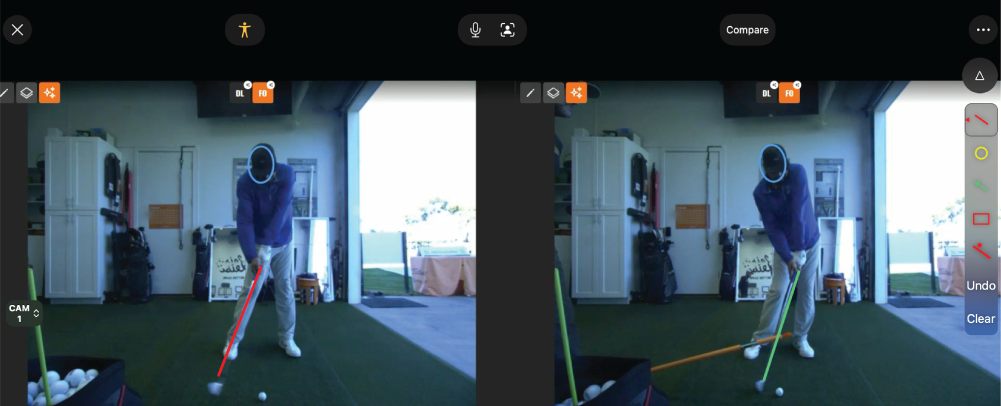
Onform’s side-by-side comparison is what I use for visual confirmation of the change. I can put the before next to the after, sync them at impact and show the difference. This is very powerful and motivating to the student. This is where the student stops relying on feel and starts relying on evidence.
The golfer isn’t walking away with just some tip and a lack of understanding why they are moving the way they move. They’re walking away with changes that are tied directly to strike quality.
The hour doesn’t fail because golfers don’t try. It fails because golfers forget. The real dilemma in golf coaching is retention — getting the student to leave the lesson and still train the right thing three days later when life and old habits come back.
This is where Onform becomes more than analysis. It becomes infrastructure. I have read that some estimate that golfers forget 80% to 90% of what was said in a golf lesson within one hour of it finishing.
I use Onform’s communication tools to turn the lesson into a permanent reference. I’ll record a screencast recap directly over the video, walking the student through the exact changes we made and why they improved low point.
I’ll point out the measurable differences — reduced sway, less thrust, improved posture, and a clearer path to forward shaft lean, rotation and compression. Then, I send the drill clips and the recap to the student’s Onform feed.
When they’re at the range later, they aren’t guessing. They have the blueprint in their pocket: what to do, how to do it, and what the correct version actually looks like.
One hour is absolutely a challenge, but it is not a limitation. Commit to ball striking as the priority and do not waver.
Remember this, Jim Furyk’s and Adam Scott’s swings both work. Focus on what you can control as a golfer and verify via visual feedback.

As the founder and head coach at EJS Golf at McCormick Ranch in Scottsdale, Arizona, Erik Schjolberg has dedicated over 30 years to perfecting the art and science of golf instruction. His mission is to ensure that every golfer who steps into his teaching bay experiences measurable improvement from their very first lesson. He hopes to help other coaches learn how leveraging the right tech can improve a golfer’s performance and ability to retain what they learn during lessons.