
One of the most common patterns I see in my players is a downswing that starts with the upper body, sending the club “over the top,” and leads to weak contact, slices, and inconsistent ball flight. The good news is you don’t need to be a world class athlete to fix this issue.
Below are three foundational concepts and practice drills I use with players of all skill levels. When combined, they help shallow the club, improve weight shift, and create the athletic extension needed for solid, powerful strikes.
1. Stop the Over-the-Top Move and “Chicken Wing”
Drill: Split-Grip Shallowing Drill
An over-the-top move often shows up with a “chicken wing” through impact—where the lead arm folds and the club cuts across the ball. This happens when the trail arm dominates the transition and the club steepens early in the downswing.
The goal:
Shallow the club naturally by allowing the trail hand to fall behind you during transition.
How to do the drill:
- Take your normal stance, then split your grip so your trail hand is down at the bottom of the grip, almost on the shaft.
- Swing to the top of your backswing.
- From the top, focus on letting your trail hand drop down and behind you while keeping your lead hand in the same spot. You will notice your hands are becoming level with each other.
You should feel and notice the club fall behind you rather than the club and your hands more out in front.
This motion places the club on a better delivery plane, allowing it to approach the ball from the inside or at least less from the outside.
Key coaching cue:
“Let the trail hand fall—don’t throw the club.”
Common mistake:
Trying to actively reroute the club with the arms. Let gravity and sequencing do the work.
Make it better with Onform:
Using the Onform app. Record yourself from down the line (camera pointed towards your target). If you see the clubhead trace in a clockwise direction from the top (for a right handed player), you are still coming over the top. You will be seeing the club is getting steeper (more vertical) rather than shallowing behind you (getting more horizontal). Past impact, we should see the clubhead exit your lead side before we see your lead elbow. If you see the elbow first, this is the chicken wing we want to eliminate.

2. Sequence Your Weight Shift Correctly
Drill: Tailbone-to-Target Transition
Proper weight transfer begins from the ground up, not from the shoulders or arms. When the upper body initiates the downswing, the club steepens and the low point moves making it hard to find solid or consistent contact.
The goal:
Start the transition and downswing with the lower body while keeping the upper body patient.
How to do the drill:
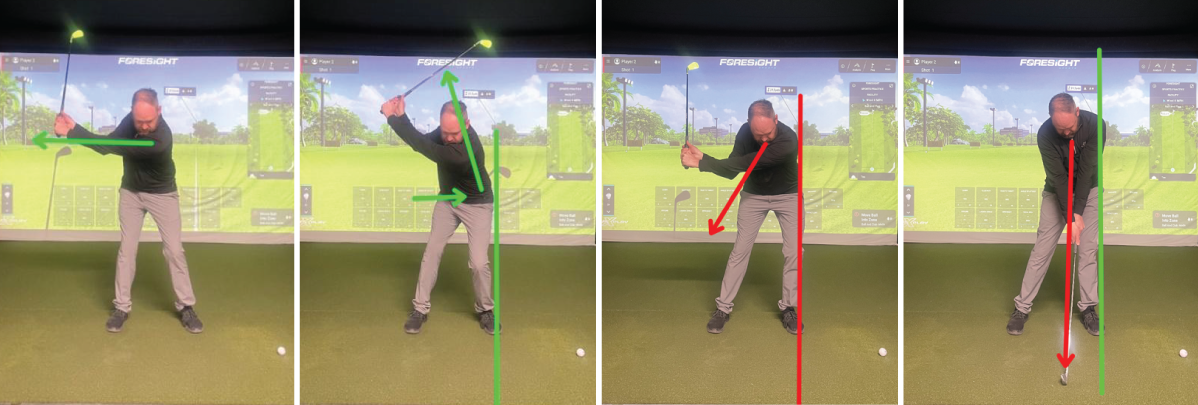
- Imagine an arrow coming out of your tailbone.
- As your lead arm becomes parallel to the ground in the backswing, begin your weight transfer by pointing that imaginary arrow more toward your target.
- This movement shifts pressure into your lead side while finding a little more rotation in your back swing.
This Ultimately triggers and allows more time for sequencing to happen on the down swing.
Key coaching cue:
“Lower body leads, upper body reacts.”
What you should feel:
Pressure moving into your lead foot before the club starts down.
Make it better with Onform:
Using the Onform app, record from face on. You should see as the club is about to come down, that lead hip is over lead ankle. Your head should also be further from your target than your lead hip. Then through impact we should see your lead side as a straight line.
3. Jump
Drill: Impact Jump
Many players bend their legs coming into impact, becoming heavy on their feet. This restricts rotation, stresses the joints, and makes low-point control inconsistent.
The goal:
Create athletic extension through impact.
How to do the drill:
- Swing to the top of your backswing.
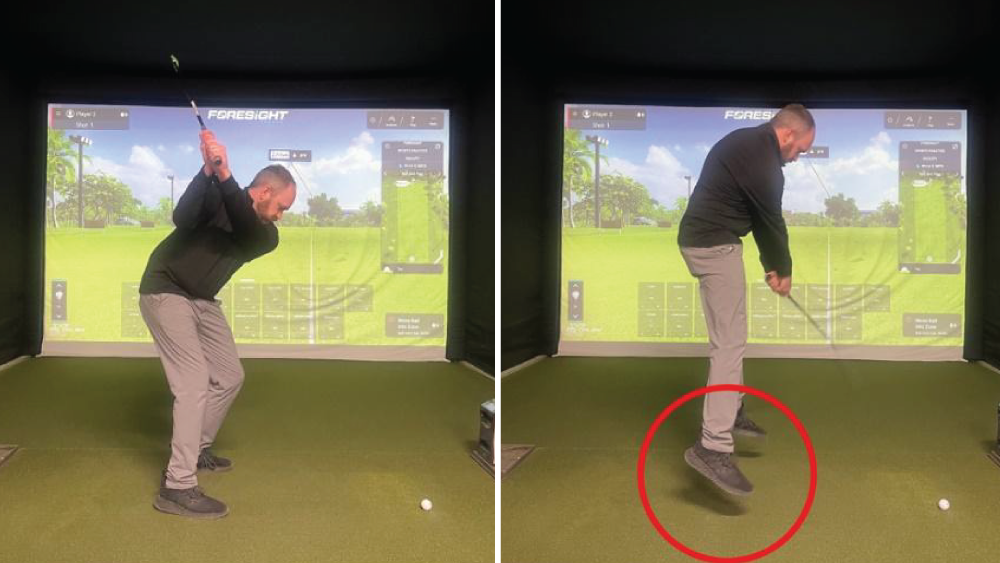
- On the downswing, jump off the ground before the club reaches the bottom of the arc.
- Do not worry about hitting a ball —this is about timing and sensation.
- Once you understand the feeling, repeat the swing while keeping your feet on the ground but maintaining the same extension intent.
This drill trains your body to get lighter through impact, improving club speed and reducing stress on your knees and lower back.
Key coaching cue:
“Allow hips or belt buckle to move up through impact.”
What you should notice:
Improved balance, better contact, and more effortless speed.
Make it better with Onform:
Using the Onform app, record from down the line. As the club is coming down to the ground, your feet should leave the ground. Once that can happen, you will notice that both legs are extending before impact. As you start keeping your feet on the ground and see the same extension on both legs before impact while you maintain your posture.
How These Three Drills Work Together
When practiced consistently:
- The split-grip drill fixes club position
- The weight-shift drill fixes sequencing
- The jump drill fixes extension and helps with speed
Together, they can eliminate improper motions, and allow you to swing athletically rather than mechanically.
Train With Purpose
These drills are most effective when practiced slowly at first and then start to build speed into full swings. If you are struggling to feel these movements or want them customized to your swing, seeking help from a PGA professional is the fastest road to success.

Gary Hartford is a Class “A” golf professional and certified instructor with the PGA of Canada, currently based at Highlands Golf Club in Edmonton, Alberta. He grew up in Edmonton, started playing golf at a young age, and developed his passion for the game both on the course and through community-oriented programs early in his career. Hartford has competed in national PGA of Canada events as a player and transitioned into golf coaching and instruction, where he focuses on teaching golfers of various skill levels, sharing his experience from competitive play and professional development. Alongside his golf career, he is noted for his enthusiasm for the sport and involvement in golf operations and program leadership within his local golf community.