
When Harry Tanner started instructing at the X-Golf location in Fort Collins, Colorado, there were only 14 other locations across the country. Today, as the Director for X-Golf America, Tanner is astounded by the rapid growth of the indoor golf simulator franchise, which now totals more than 130 locations nationwide.
In addition to recreational play, corporate events, leagues and tournaments, many X-Golf locations feature lessons from PGA-certified experts like Tanner.
While he doesn’t teach as much as he used to, when he does, Tanner combines the state-of-the-art virtual setup of the X-Golf Simulators with the ease-of-use and instant video analysis from Onform.
This combination is used across more than a dozen X-Golf locations nationwide today.
“I wanted a mobile teaching system for this environment, which has its difficulties in teaching to a certain degree just based on the fact that there’s always people in and out. It’s not necessarily a controlled environment all the time,” he said. “Onform solves for that.”
Easy Setup Ideal for X-Golf Simulator Bays
The mobility and “plug-and-play” format of the Onform platform allows Tanner to easily set up and break down, perfect for the modular nature of X-Golf locations, with bays often booked back-to-back.
“The ability just to use my phone, my iPad, and my MacBook — which I already have on me — is perfect. And it’s a really easy setup,” he said. “Everything’s magnetized. I don’t have to hook up a bunch of wires or configure a bunch of stuff.”
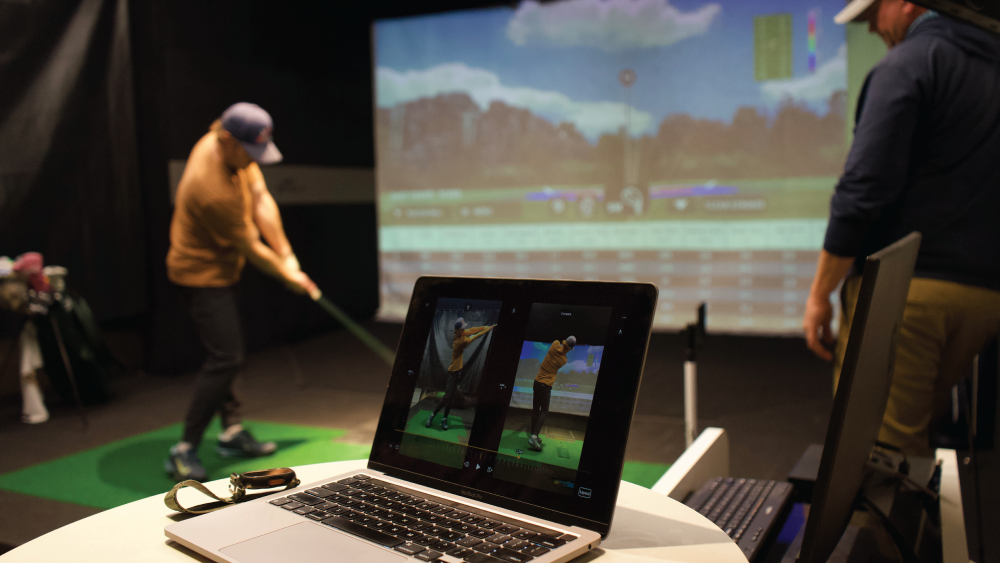
Tanner’s setup allows students to practice irons on the virtual range or play a round at one of many notable virtual courses like Bay Hill, while also getting instant video playback on their mechanics through Onform.
Tanner’s iPad and phone sync to his laptop, which is broadcasted to a mounted television in the X-Golf bay. This way, students are able to see the swing metrics from the simulator, then turn to the TV for a two-angle breakdown of why that swing was good or bad.
“It allows me to show biometric feedback based on rotation numbers, bend numbers, things like that, things that I’m used to from a previous background of using that kind of information,” Tanner said. “So it is a completely seamless tool being able to use all that stuff without having to hook anything up to do it.”
Technology as a Teaching Tool, Not a Distraction
A central theme of Tanner’s teaching philosophy is using video and biometric feedback to show students the difference between what they feel they are doing and what they are actually doing.
His main objective of the whole lesson process is to get students to learn how to react correctly on the golf course so they can hit the shots that they know they can hit and execute what they know they can do.
Tanner believes visual evidence is essential for students to trust and execute aggressive swing changes.
“Most people don’t see what they feel, right? And you’re able to match the reality of what you’re doing versus what somebody wants you to do,” he said. “I think you’re then able to really accomplish things moving forward.”
While Tanner utilizes advanced metrics like rotation and bend numbers along with multi-camera setups, he emphasizes that technology should remain a secondary tool. He advocates for a “simple start” to avoid overloading students with “eye candy” or excessive data.
“There are so many different tools in golf instruction these days. Being able to use those tools without overusing them is really a trick and something that you have to learn to do,” he said. “You can definitely overload students in the beginning, and I think the more that you learn not to do that, I think the better those students can be in the long run.”
Seeing Is Believing: Noticeable Improvement for Tanner’s Student
Tanner has been working with Brian Kleaver for more than three years and has enjoyed using Onform as a student. Kleaver trains with Tanner at X-Golf twice a month, but being able to “take the lessons home” has been a game-changer in his development.
“Being able to have my best swings cataloged on the app for me to study and analyze at home has been awesome,” Kleaver said. “It’s really just about having full autonomy as far as getting the notes from Harry and the details I needed to improve my game.”
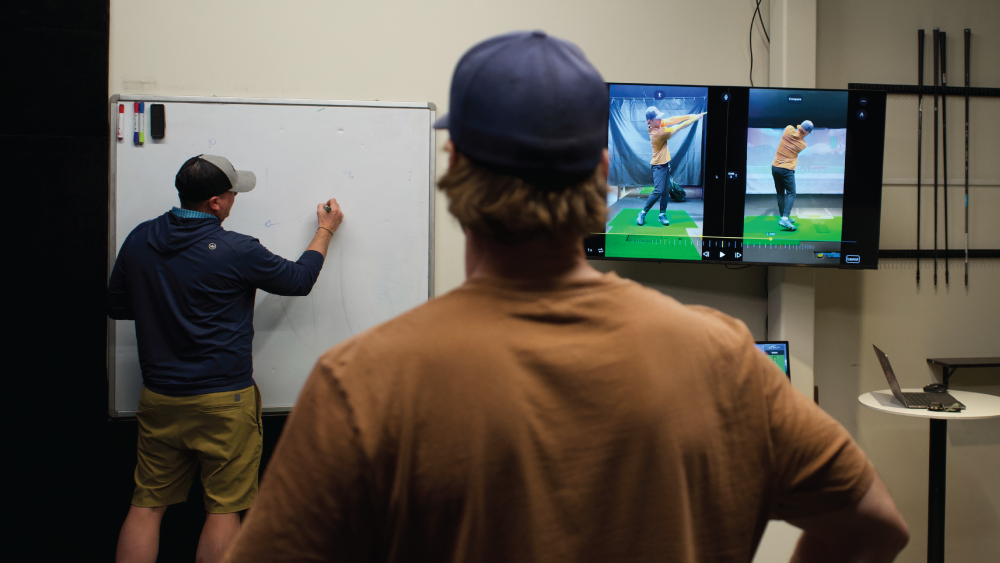
Tanner says all of his students use Onform differently. Some are only exposed to it during lessons, while others like Kleaver use it as a record of progress to study when he isn’t in an X-Golf hitting bay.
“I’m using it as a tool for what Harry films during my lessons,” he said. “I can sit there and look at the 3D image and look at the slow-mo and really focus on what I need to improve on for the next lesson and what I’ve improved on since that past lesson.”