
Do you ever wonder why some “ugly” swings produce 300-yard drives while “perfect” looking swings stall out at 220?
Many coaches, especially newer instructors, focus on the takeaway, the depth of the backswing, or the position of the club at the top. But any seasoned coach has seen a student with a textbook swing who struggles to break 90, while a player with a quirky, unorthodox motion consistently flushes it.
The difference often lies in something the naked eye can’t quite catch: kinematic sequence.
Essentially, the kinematic sequence is the signature of how a golfer transfers energy from their body to the clubhead. It’s not about how the swing looks. It’s about the order in which body parts accelerate and — more importantly — decelerate. The Titleist Performance Institute (TPI) says the kinematic sequence is “probably the number one most important piece of information” that they use in assessing a new golfer. For a coach, understanding this sequence is like having an X-ray of a student’s power source.
What Is Kinematic Sequence in Golf?
The kinematic sequence describes the order and timing in which different body segments accelerate during the golf swing. It is visualized by plotting the angular velocities of key body segments throughout the swing.
In an efficient golf swing, rotational energy is generated by the body and transferred sequentially through the kinetic chain — from the lower body to the club. This results in a characteristic pattern where the pelvis accelerates first, followed by the torso, arms, and finally the club.
Analyzing the kinematic sequence provides valuable insight into how a golfer generates power and how effectively that power is transferred through the body.
Deviations from the typical sequence pattern may indicate issues such as inefficient timing between segments, poor energy transfer, or compensatory movement patterns.
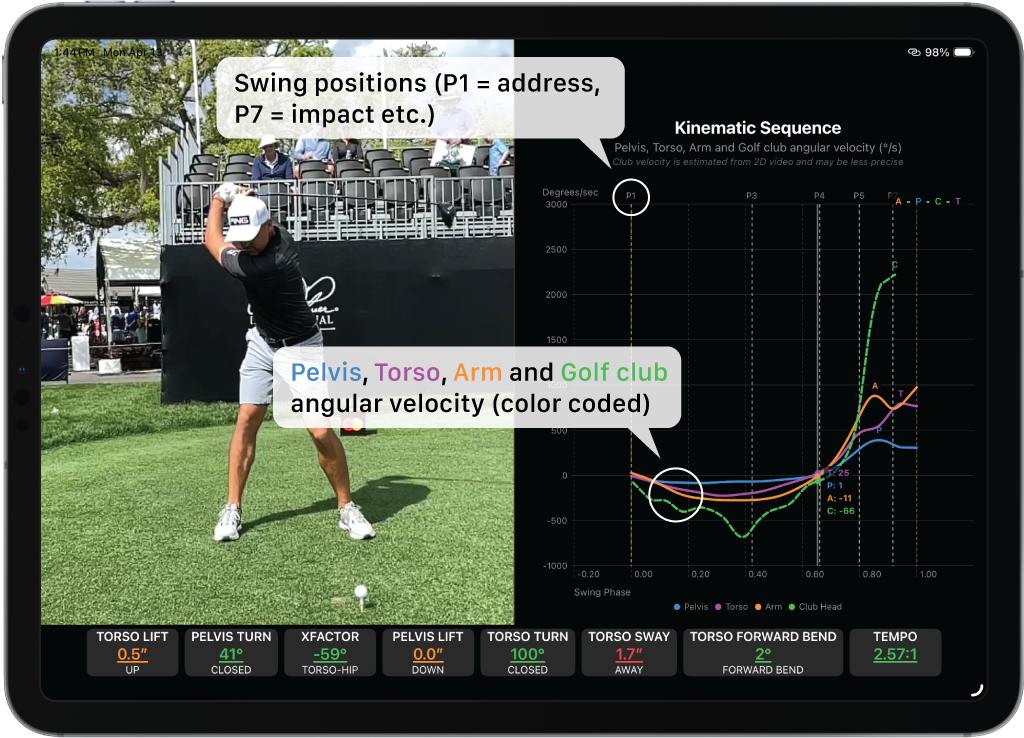
Understanding the Segments of the Kinematic Sequence
The analogy of a cracking whip is often used to explain kinematic sequence in a golf swing. To make the tip of a whip snap, you don’t just move your whole arm at once. You move the handle, then abruptly stop it, passing that energy down the line.
In a golf swing, that energy moves through four main segments in a specific, proximal-to-distal (inner-to-outer) chain:
- The Pelvis: This is the engine. It starts the downswing, reaching its peak rotational speed first.
- The Thorax (Upper Body): As the pelvis begins to slow down, it passes that speed up to the torso.
- The Lead Arm: The torso then decelerates, catapulting the arms forward.
- The Club: Finally, the hands slow down, and the energy is dumped into the clubhead at impact.
When this chain works correctly, the golfer achieves maximum speed with minimum effort. When it doesn’t, they are essentially “fighting” their own body.
Identifying ‘Power Leaks’ in Your Students
Most amateur golfers suffer from a “top-down” sequence. Instead of starting with the pelvis, they fire their shoulders or hands first. This is the root cause of the classic “over the top” move and the dreaded slice.
As a coach, identifying these “power leaks” becomes much easier once you look for sequence issues rather than just swing planes:
- The Amateur Pattern: Often, the hands and shoulders peak in speed at the same time as the hips. This is like trying to crack a whip by moving the whole string forward at once — there’s no snap.
- The Deceleration Problem: A common misconception is that every body part should keep getting faster until impact. In reality, the pelvis must slow down so the torso can speed up. If a student “spins out” their hips without ever braking, they never actually transfer that energy to the ball.
- The Result: You’ll see casting, an early release, or a student who looks like they are swinging 100 mph but the ball is only traveling 200 yards. They are working hard, but their sequence is inefficient.
Using Onform’s Kinematic Sequence Feature
Historically, measuring kinematic sequence required a high-tech setup, with electromagnetic sensors taped to the student and wires everywhere. For the average club pro, it simply wasn’t practical.
With Onform’s new Kinematic Sequence feature, you can stop guessing about the energy transfer in your student’s swings by simply recording them as normal with an iPad or phone.
Our new Kinematic Sequence Graph shows you how the pelvis, torso, and arms accelerate to create power, allowing you to see the timing, find the speed, and help your students hit the ball further.
Video Capture Guidelines
| Parameter | Recommendation |
| Camera Angle (Face-on) | Just as it does for 2D video, recording angles matter. We recommend pointing at the centre of the golfer, ideally perpendicular to the target line. Try to keep the camera as level as possible. |
| Camera Height | Place between waist to chest level of golfer |
| Distance from Golfer | Golfer’s height is at least 50% of the video frame |
| Lighting | Well-lit, evenly distributed |
| Clothing | Avoid loose, baggy outfits that obscure joints |
| View Obstructions | Ensure the full body is visible throughout the swing. If possible, avoid background noise, such as other golfers. |
How to Integrate It Into a Lesson:
- Capture: Record the student from a face-on perspective at a high frame rate (120 fps or higher).
- Compute: Onform’s AI analyzes the motion of the pelvis, thorax, and lead arm, generating a kinematic graph in seconds.
- The Visual Proof: Instead of telling a student they are “using their arms too much,” you can show them the graph. If the “hand speed“”” line peaks before the “pelvis” line, the student can see the evidence of their inefficiency.
This allows you to move from “I think you’re doing this” to, “The data shows you’re doing this.” It builds immediate trust and gives the student a clear, measurable goal for their next practice session.
Rose, G., & Phillips, D. (n.d.). Kinematic sequence basics. MyTPI. https://www.mytpi.com/articles/biomechanics/kinematic-sequence-basics
fitzygolfpro. (2017, April 2). The kinematic sequence of a golf swing explained simply [Video]. YouTube. https://www.youtube.com/watch?v=6TXod7SmRTU
Onform. (2025, September 30). Feature release: 3D data now available for golf. Onform Blog. https://onform.com/blog/feature-release-3d-data-now-available-for-golf/
Onform. (2025, September 30). Onform launches fast, reliable, and accessible markerless 3D motion capture for golf. Onform Blog. https://onform.com/blog/onform-launches-fast-reliable-and-accessible-markerless-3d-motion-capture-for-golf/
The kinematic sequence feature looks very interesting. Is it available for athletes?
Yes, it’s available for athletes on the premium tier!