
Most sports today have embraced technology — whether its lab testing to get marginal gains as a professional cyclist or force plates in golf to measure ground reaction forces and pressure distribution during a swing to optimize power, efficiency, and consistency.
Iván Villalba, a self-described “super nerd” with a background in filmmaking, is bringing a similar approach to coaching his sport and lifelong passion: surfing.
Villalba’s coaching is rooted in high-fidelity video analysis. When his previous analysis tool was discontinued, his search for a replacement led him to Onform.
For Villalba, the platform is more than just a recording tool. It is a “digital mirror” that bridges the gap between what a surfer feels and what they are actually doing.
“The video is like the mirror”, says Villalba. “When you are in the gym and the coach tells you the squat has to be lower, you look in the mirror and say, ‘It’s true.’ In my mind, I thought I was lower, but when I check the mirror, I’m not low enough.”
How Iván Villalba Built Elite Surf Coaching
Villalba’s journey didn’t begin with immediate success. He started surfing in 1991 and entered his first competition just one year later. It was a disaster that served as his greatest catalyst.
“That competition changed all my perception of surfing,” he recalls. “It was like the trigger, the switch. I made all the mistakes you can do in one hit. I did everything wrong.”
That failure sparked an obsession. He began training six to 10 hours every day, quickly rising through the ranks in Spain. His mindset was defined by a specific philosophy: “I prefer to be the tail of the lion than the head of the mouse.” This drove him to leave the comfort of local wins to compete on national and European stages.
While working for Billabong for over a decade, Villalba spent his summers managing intensive surf camps for kids. However, when the 2013 economic crisis hit Spain and his corporate role ended, he found himself at a crossroads.
Rather than joining the dozens of surf schools teaching beginners in the Canary Islands, he pivoted to something no one else was doing: high-performance technical coaching.
“In that time, the surf coach was related only to top athletes,” he explains. “I thought, you know what, if I’m doing coaching no one else can do, I don’t want to have any competition.”
How the Pandemic Shaped the Business and Coaching Industry
In 2013, Elite Surf Coaching was born, eventually leading Villalba to establish a permanent base in Bali in early 2020 — just as the world was about to change.
This timing, at the start of the COVID-19 pandemic, was described as the “worst moment” for a travel-dependent business, forcing the cancellation of a fully booked year. Many of Villalba’s clients could not travel to Indonesia, leading to a shift in behavior and an embrace of remote coaching.
Prior to the pandemic, Villalba used remote analysis only for competitive athletes, as normal clients preferred in-person coaching to enjoy the full experience in paradise locations. However, the pandemic drastically changed this, making remote coaching more of the norm.
Villalba noted that the rise of wave pools has also increased the potential for remote coaching, since it’s a more controlled environment and easier for an athlete to record themselves.
Powering Surfing Performance with Onform
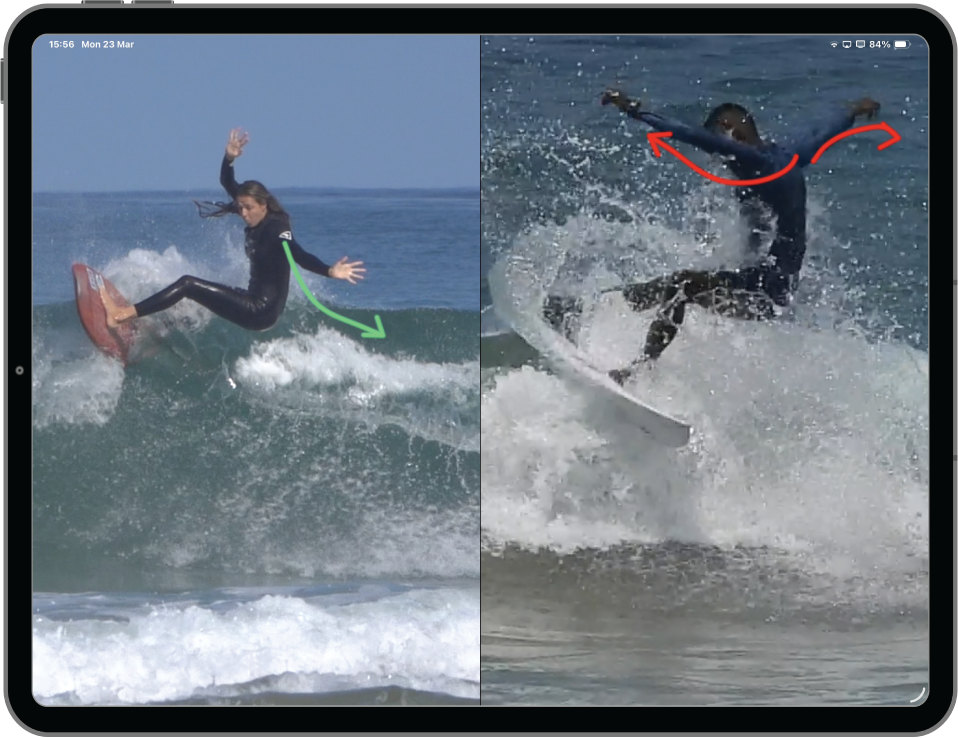
Villalba discovered Onform after his previous video analysis tool was discontinued. While there are no video platforms that cater specifically to surfing, Villalba found Onform’s precise markup tools useful in illustrating subtle differences in technique.
He uses a color-coded system — green for correct movements, red for errors — and even adjusts the thickness of his lines to denote different priorities.
“When I’m showing the path the surfer takes, I draw the line of the surfer with a thick line, but when I show the eyes and where they have to look, I use a thin line,” he explains.

Villalba’s workflow is meticulous. Whether on his home beach in Bali or onsite in India or China, he films in blocks, then conducts deep-dive analysis sessions two hours later.
This process isn’t just for in-person camps. The pandemic accelerated his remote coaching capabilities. Using Onform’s cloud-based system, he can now coach athletes around the world, providing the same level of technical scrutiny as if he were standing on the beach.
“It’s perfect because we often think we perform better than we actually do,” he said. “The video doesn’t lie. It allows the surfer to see themself and say, ‘OK that could have been better,’ even if it felt good in the moment. It’s super humbling.”
Coaching the Coaches: Elevating National Standards
Villalba’s expertise is increasingly sought after, not just by individual surfers, but by national organizations looking to professionalize their coaching staff. Recently, he has been working with India’s national team, applying his rigorous methodology to help their instructors refine their own technical eyes.
In these “coach the coach” sessions, Villalba uses Onform to build a library of reference content. He compares student footage against a database of the best surfers in the world to help instructors recognize the biomechanical markers of success.
“I have my professional athletes that are already top five in the world,” Villalba says. “By superimposing these elite movements over a student’s video or using split-screen comparisons, I can show how to spot the nuances of compression, stance, and trajectory.”
Whether he is pushing an athlete under the pressure of a mock heat or showing a hobbyist why their “cutback” is losing speed, Villalba’s goal remains the same: using technology to ensure that every surfer has a clear path to improvement.