
Roger Young has been using video to coach riders since 1988, long before phones, apps or instant replay. Back then he used a drawing pad interface over videos. Over the years he tried a range of digital editing platforms, including tools that are still around today. When his previous app went out of business, he needed something simple, fast and reliable. That’s what brought him to Onform.
“Simplicity and speed. It’s just so easy to make learning it so useful.”
For Roger, those two qualities matter more than anything else. Cyclists move fast. Training sessions move fast. Feedback needs to move fast. Onform fits directly into the way he coaches, both on the track and remotely.
Why Video Is Essential in Cycling
Riders often pass Roger at nearly 60 kilometers per hour. At that speed, even the most experienced coach cannot see everything with the naked eye and yelling cues simply does not work. When a rider gets off their bike, he replays the video for them immediately, and uses the drawing tools to point out small details.The short time between riding and seeing their videos helps them learn faster.
He also relies on video to understand interactions between riders during group drills and tactical work. Movement happens too quickly to catch in real time, but slowing footage down or scrubbing frame-by-frame reveals what live coaching cannot.
Why Static Bike Fits Fall Short
Bike setup is often treated as a static process. Riders sit on a trainer and hold a position while measurements are taken. Roger explains why that approach misses critical details.
“When a rider is actually riding, they change posture depending on the particular task. When accelerating, they move forward in the saddle. While riding steadily, they sit mid-saddle. But there are as many postures as there are fret positions on a violin. So the ability to freeze a rider in action vs on a static bike trainer allows me to measure joint angles, aero drag, and frontal areas and make adjustments that are way more meaningful.”
Even in a wind tunnel, riders do not move exactly the way they do on the track. Onform allows him to capture a rider’s true position in real riding conditions, where posture, torque, fatigue and speed all influence form.
How Roger Uses Onform in Real Coaching Sessions
Roger has three primary workflows inside Onform.
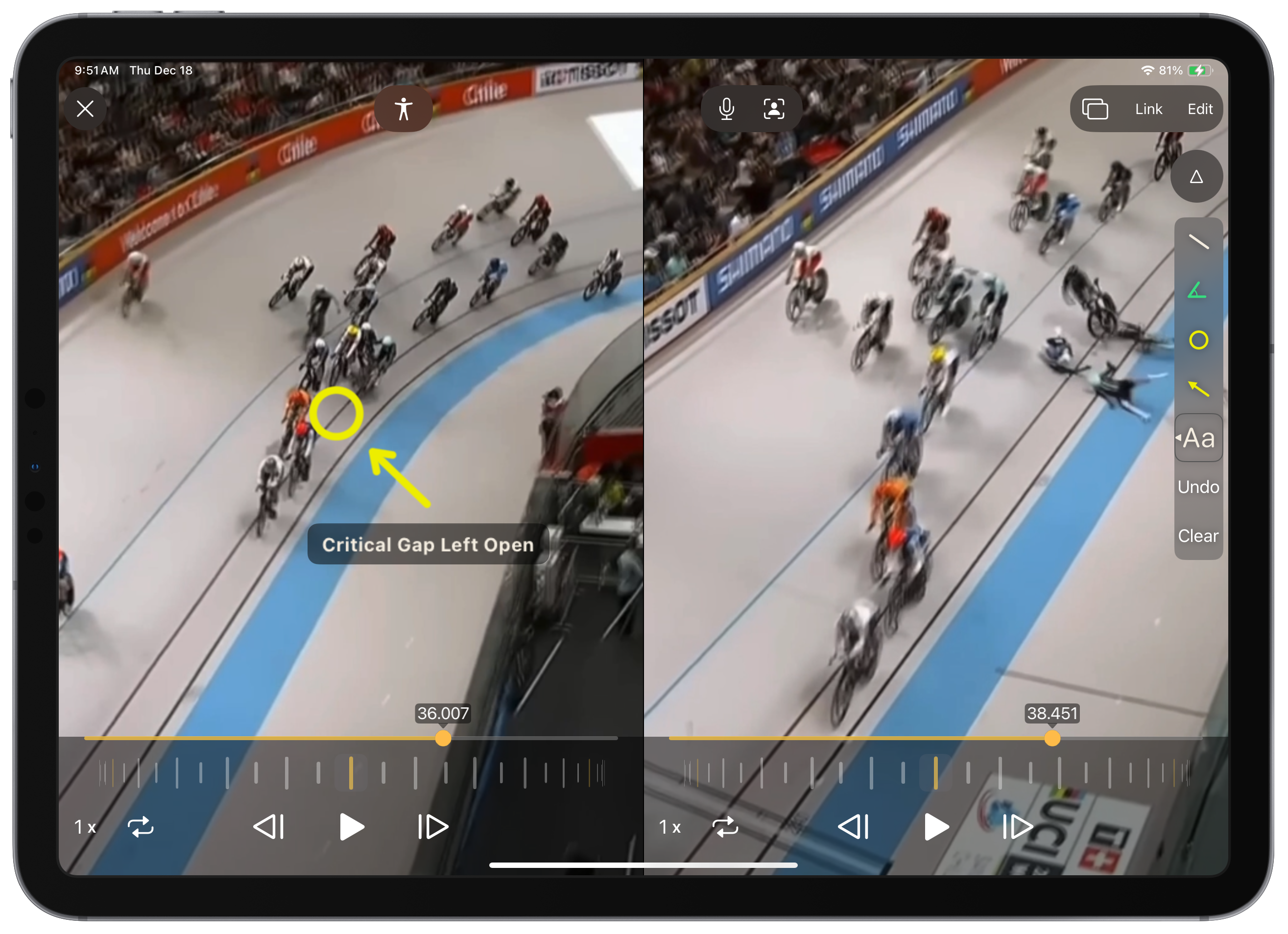
- Race footage evaluation – He receives videos from riders, parents or assistants, then records voice-over narration and uses drawing tools to critique the race. He sends that edited video back to the rider and their support group so everyone understands the teaching points.
- Drill review – During training, Roger films specific drills and then immediately meets with riders to review the effort. I do a quick conference with the rider(s) using Onform to critique the drill giving (mostly) positive reinforcement and some ‘you’ll want to try it the other way’ kind of advice.”
- Bike setup and positioning – For starts, accelerations and high-speed efforts, Roger records the movement and uses Onform to check angles, outline areas of drag and visually explain how to optimize the setup.
A Real Example of Onform Driving Performance
Roger often uncovers subtle but meaningful issues through video.
“This year I noticed a rider spending too much time out of the saddle when accelerating. This unnecessarily presented a large frontal area. We spotted the best time to go seated and the rider carried more speed through the acceleration, winning him a National Championship title.”
While it would have been nearly impossible to diagnose this in real time, slowing down the video to review made the solution obvious.
Faster Learning, Better Decisions and Safer Racing
Onform’s fast communication loop is central to Roger’s coaching. “Riders get the information fast via the chat feature. Riders often are still out of breath with the proprioceptive feedback still fresh.”
He also uses video to improve tactical awareness. Watching races and reviewing situations with riders helps them understand strategy and decision-making more deeply. By studying other riders, other tracks and other situations, athletes develop a clearer sense of how to respond in real race environments.
Roger’s story shows how powerful coaching becomes when experience and technology work together. Onform speeds up the feedback loop, makes technical details easier to communicate and allows him to capture what really matters: how riders move in real time. It enhances the systems he has built over decades and gives his athletes clearer insights, faster corrections and more confidence in their training.
For coaches looking to deliver stronger, more personalized instruction without adding complexity, Roger’s workflow is a reminder that simple tools, used well, can make a meaningful impact. Onform’s role in his coaching is not about replacing anything. It is about sharpening his eye, strengthening communication and helping riders improve at a pace that matches their potential.
Ready to Get Started?
Download Onform from the App Store or Google Play to start your 14-day free trial and begin exploring live coaching with your students.
If you have any questions or want to see how Onform can fit into your coaching business, we’d love to connect. Schedule a call with our team at your convenience.