
Most tennis instructors will agree that successful coaching emphasizes adaptation based on a player’s individual strengths, physical attributes, and playing style.
I don’t believe there is one perfect way to swing a racket or move across the court.
After decades of coaching in Italy and recently serving as the Technical Director of the Mauritian Tennis Federation, I firmly believe that coaching is about understanding an individual player’s unique biomechanical profile — not forcing them into a pre-defined mold.
The challenge for most coaches is that tennis happens at a speed the human eye simply cannot capture. When a player strikes a ball, we see the result, and we see the general movement of the body, but we often miss the “why” behind a breakdown in the kinetic chain. This is why I have integrated advanced video analysis — specifically through the Onform platform — into the core of my methodology.
The Foundation: Lateral Dominance and the Individual Profile
Before I ever record a single stroke for analysis, I begin with a lateral dominance test. This is a critical step that many coaches overlook. Every athlete has a dominant eye, shoulder, hip, hand, and leg. These physiological traits dictate how a player should naturally interact with the ball.
Consider the current rivalry between Jannik Sinner and Carlos Alcaraz. If you compare their forehands, one plays with a bent arm while the other utilizes a straight-arm finish. This isn’t necessarily a choice of style; it is an influence of their unique physical characteristics and dominant traits. As coaches, if we try to force a straight-arm player to use a bent-arm technique, we aren’t just changing their form, we are fighting their biology.
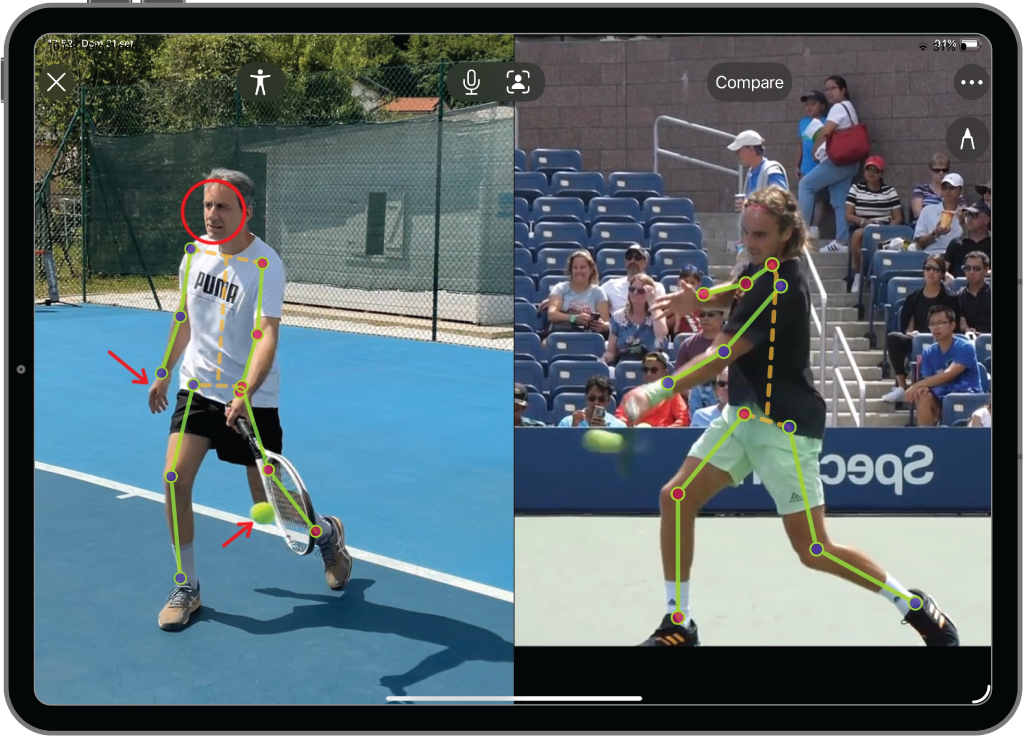
By identifying these dominances first, I can then use video analysis to find a professional “comparison player” who shares a similar physical profile. Using a side-by-side, dual-screen setup, I can show a student how a top-tier pro with a similar build optimizes their movement. This makes the goal attainable and biologically sound, rather than asking them to mimic a player they can never truly emulate.
Leveraging Video for Deep Analysis Reports
The beauty of modern video technology is that it allows us to bridge the gap between what we feel as coaches and what is actually happening with the player’s body.
I utilize video analysis in two primary ways: live on the court for real-time feedback and through deep-analysis reporting following training sessions.
The Power of Before and After
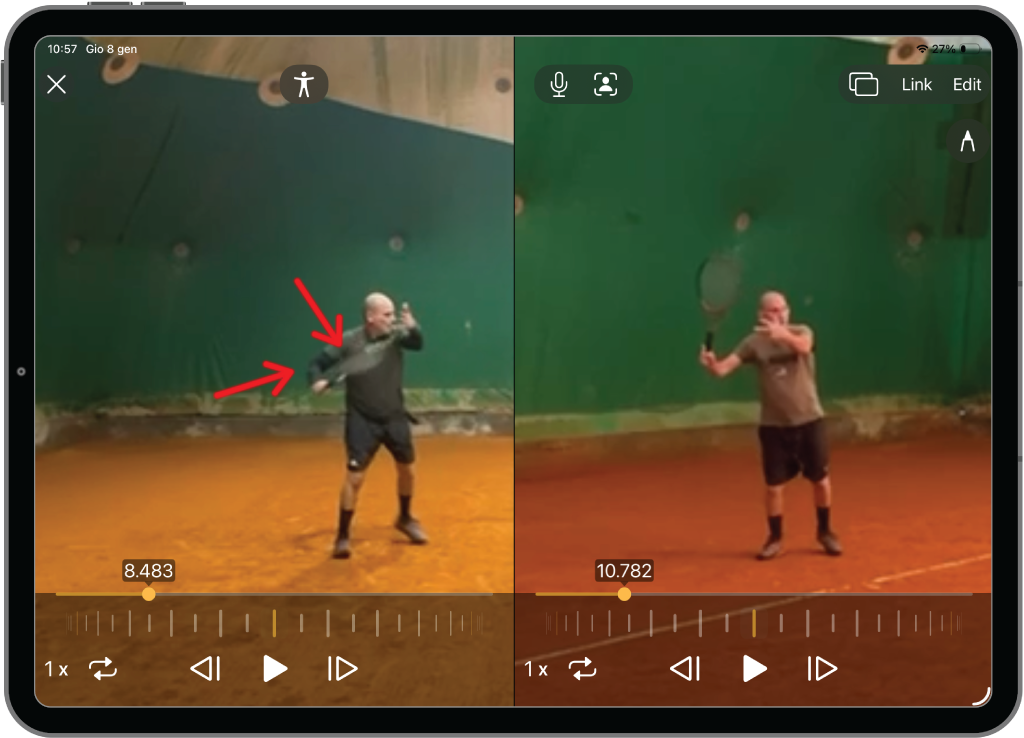
When working with my long-term clients in Italy, I often use a tripod and an iPad right on the court. My favorite technique is what I call the “silent correction.”
Instead of telling the player what they are doing wrong, I take a video of their current form. Then, I provide a technical correction and have them play for a few minutes. I take a second video and immediately show them the side-by-side comparison.
Seeing is believing. When a player can see that their hip is now rotating five degrees further or that their contact point has shifted forward in just a five-minute span, their confidence in the change skyrockets. This immediate feedback loop is far more powerful than verbal instruction alone.
Deep Analysis from a Remote Session
Not every coaching session needs to happen in person. I frequently work with players who I am not previously familiar with who send me footage of their play through my website.
For these athletes, I create a comprehensive PDF and video report. I use Onform’s drawing tools — lines, circles, and frame-by-frame snapshots — to show exactly where the kinetic chain is breaking down.
Many coaches feel they don’t have the time to spend a full day analyzing one player’s footage. However, by acting as a specialist who provides these deep dives, I’ve found that even other coaches are happy to receive my reports. It gives them a roadmap to work with their players more effectively.
Advice for Tennis Coaches: Look Beyond the Racket
If I could offer one piece of advice to fellow coaches, it would be this: stop focusing solely on the racket. The racket is merely the end of the chain. The movement of the racket is a result of how the body functions.
Technology allows us to slow down the world. In a sport as fast as tennis, video analysis is the only way to truly see if a player’s shoulder and hip are working in harmony.
Do not be afraid to embrace these tools. Some coaches worry that technology makes the lesson feel less personal, but I have found the opposite. Using a platform like Onform shows your players that you are looking at them — specifically them — and not just applying a generic model to their game.
Whether you are working with a high-performance junior aiming for the pros or an amateur looking to improve their weekend game, video analysis provides the objective truth. It turns coaching from a game of “I think” into a science of “I know.”

Filippo Damnotti is a GPTCA C-level coach with decades of coaching age-group athletes and high-level youth players in Italy. He is the former Technical Director of the Mauritian Tennis Federation and believes in a personalized approach to coaching tennis, relying on understanding an individual player’s unique biomechanical profile and not forcing them into a pre-defined mold.