
Robert Davis isn’t your typical high school golf coach. He didn’t come up through the traditional physical education or history teacher pipeline.
Davis spent his professional career as an aerospace engineer, but he’s always had a passion for golf. That passion led him to devote his time for the past 11 years to coaching golf at Marian High School, an all-girls Catholic school in Omaha, Nebraska.
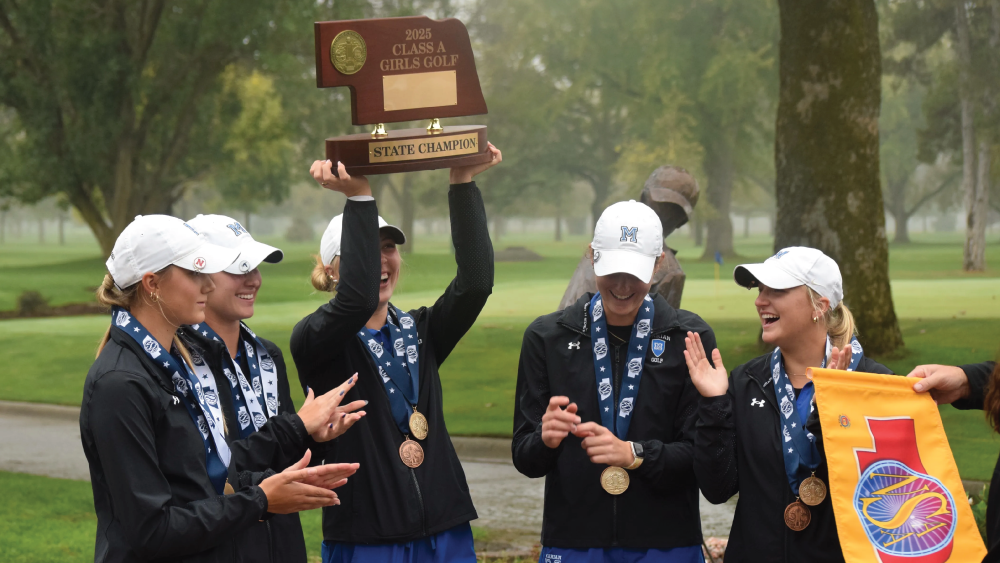
His keen eye for detail and analytical brain has benefited his coaching career thus far, reviving a once dominant program into back-to-back Class A state champions.
His secret weapon? A relentless focus on technique, powered by video analysis.
“The golf swing happens so fast,” Davis explains. “It’s a one-second movement from start to impact. The downswing, which is the most important part, is a quarter of a second. There’s just no way anybody, without using a tool like Onform, is able to diagnose issues or see what’s really going on.”
“There’s just no way anybody, without using a tool like Onform, is able to diagnose issues or see what’s really going on.”
Under Davis’s leadership, Marian has not only won back-to-back state titles in Nebraska’s highest classification, but has also competed at the national level at Pinehurst, finishing 13th against 32 state champions in the 2025 Girls PGA High School Golf National Invitational.
With four of the five golfers from that national tournament returning, Davis feels optimistic about a third straight Nebraska state championship and a top 10 finish nationally in 2026.
Bridging the Knowledge Gap for Volunteer Coaches
The reality of high school golf is that many coaches are teachers filling a vacancy. They may understand the rules of the game, but they often lack the technical expertise to diagnose a mechanical flaw in a student-athlete’s swing.
Davis sees video analysis tools as the great equalizer for these less experienced coaches.
“If you could get high school coaches just to the level of diagnosis — just to the level so they’re informed enough to take a video and say, ‘This golfer’s has these three problems’ — that would be huge,” Davis said. “Most coaches are teachers who are capable of learning diagnostics if they had proper training, then possibly hand off to a private instructor to get the problems corrected.”
Using apps like Onform, Davis has moved away from the “swing your own swing” philosophy that he believes often plateaus young athletes. By capturing footage and using markup tools, even a coach with limited golf experience can show a player exactly where their movement deviates from efficient mechanics.
“When you look at the best golfers in the world, or even the best college golfers, they move in very narrow ranges. They’re very similar to each other, especially the closer they get to impact,” Davis notes. “Those movements in those certain ranges are what gets you to be consistent. If you’re serious about working on technique, you have to have it.”
Maximizing Efficiency in the ‘Sliver’ of High School Life
One of the biggest hurdles in high school athletics is time. Unlike collegiate athletes who can treat their sport like a part-time job, high schoolers are juggling heavy academic loads, family commitments, and often, sheer exhaustion.
“High school kids are very, very busy. We only get a thin sliver of the pie chart that is their life,” Davis said. “Efficiency of practice is key. They’re almost always exhausted. We need to get the most we can out of the very limited time we have with them.”
To combat this, Davis uses video to provide feedback that lives outside the practice window. He frequently records swings during the day and spends his evenings conducting voiceover reviews, including player-to-player comparisons. By the time the players arrive at the range the next day, they have a clear, visual roadmap of what to work on.
“It usually takes the form of recording during practice and then me looking at it that night and finding something,” said Davis. “I’ll send it to them in the form of a video with voiceover, using the angle tools and the timer. Even comparing my number 10 golfer to my number one golfer — they respond a lot to that.”
“I’ll send it to them in the form of a video with voiceover, using the angle tools and the timer. Even comparing my number 10 golfer to my number one golfer — they respond a lot to that.”
This “asynchronous coaching” allows the limited hours on the range to be spent on execution rather than lengthy explanations. It also provides a level of accountability that is hard to achieve with verbal cues alone.
Davis even goes as far as filming players on the course when they don’t know the camera is rolling to capture their true “competitive swing” rather than the performative swing they might produce when they see a tripod.
Creating a Unified Front: Coaches, Parents, and Instructors
In the high school space, a coach isn’t just managing an athlete; they are managing an ecosystem. Many elite high school golfers have private instructors and highly involved parents. Without clear data, these various influences can often pull a player in different directions.
Davis uses video analysis to get everyone on the same page.
“There’s really four people involved in making a change that sticks: the golfer, me, the parent, and the instructor,” Davis explains. “If you get all four of those people on the same page saying, ‘This is what we’re fixing in Charlotte’s swing this winter,’ then you’ve got a real chance. If one or two of them are wishy-washy, it’ll just fail.”
While some private instructors are initially hesitant to be held “accountable” by a high school coach’s video evidence, the results speak for themselves.
Junior Program and Indoor Golf Training Lab
Marian High School won a state championship in Nebraska every year from 2005 to 2010, but saw a title drought until Davis coached the team to a championship in 2024 and again in 2025.
Over those two seasons, Marian has won 17 of 18 tournaments in Class A Girls Golf — which comprises the largest schools in the state.
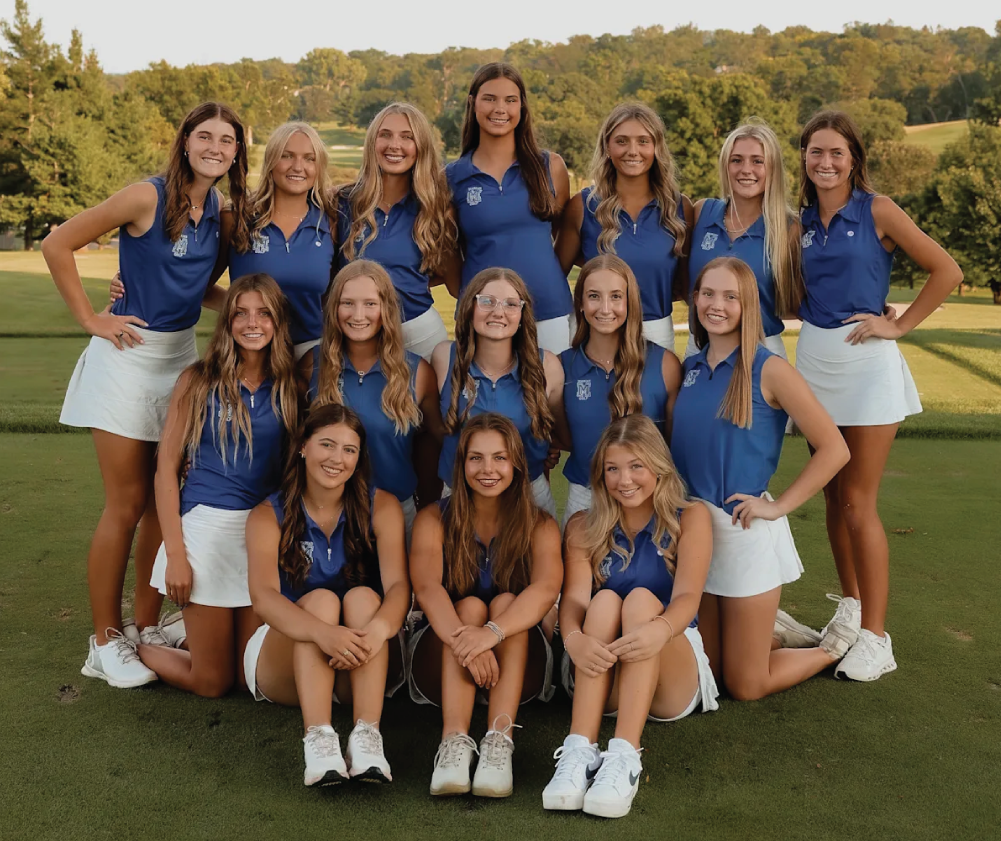
Davis credits Marian’s recent success to the junior program he helped establish and the ability to practice year-round thanks to the indoor Golf Training Lab at the Marian Athletic Center.
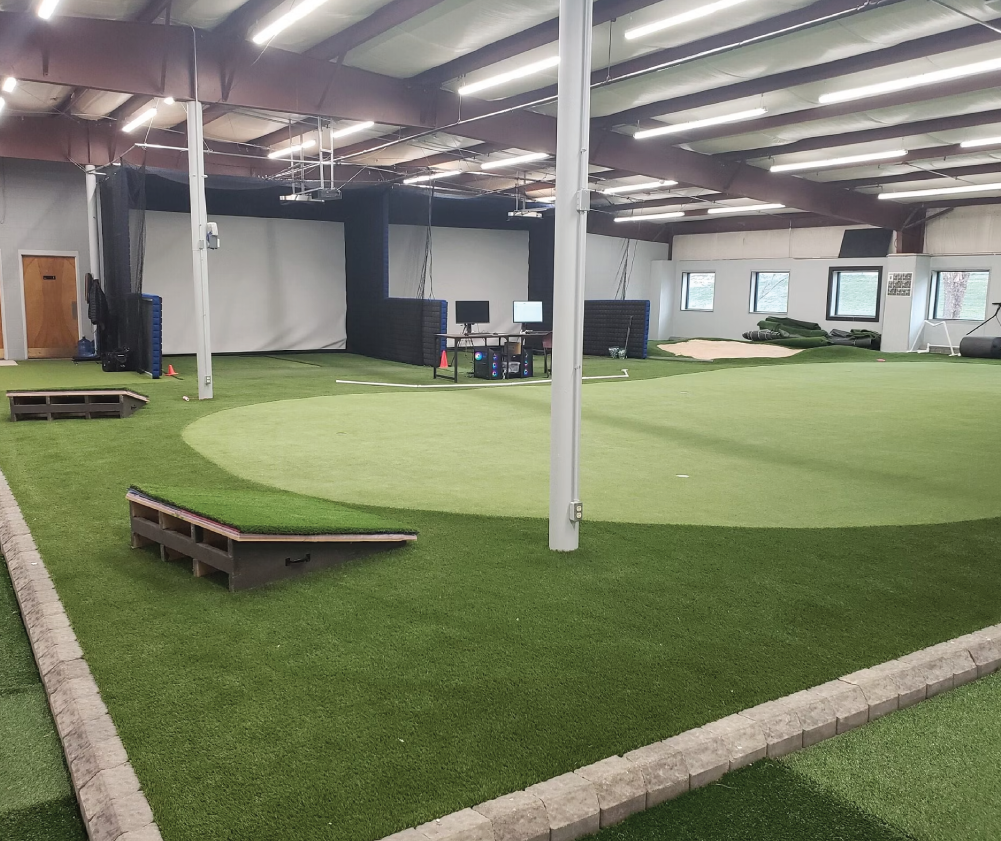
“We used to pretty much have to shut down for winter here because we’re in the -20 windchill part of the country,” he said. “We want to be a top 10 team in the country consistently, and we’re not going to be able to compete with South Carolina and Florida and Georgia unless we can do winter golf.”
“We want to be a top 10 team in the country consistently, and we’re not going to be able to compete with South Carolina and Florida and Georgia unless we can do winter golf.”
The Golf Training Lab is located in a portion of a building on the edge of Marian’s campus that was left vacant after the COVID pandemic. The lab provides the girls’ high school and junior teams with an immersive and realistic golf course environment.
The junior program, which currently has 48 girls enrolled, is designed for fifth through eighth grade students. It has created a pipeline to replace graduating talent from the high school team.
“We used to have freshmen who shot 120 or more,” Davis said. “Last season, our highest or worst scoring average on the team was 92, so I credit a lot of that to the development of these athletes within the junior program before they get to high school.”