
One of the most overlooked parts of a good golf swing is the setup. Lots of players, and even some instructors, don’t think of setup as part of the swing itself, yet legendary players like Jack Nicklaus have always said that they paid close attention to how they set up to the ball. I actually think the setup is more important than the swing—it’s what creates the swing!

With so much golf information out there today, it’s important to focus on the right things. Recently, a student sent me a setup photo (right) he found in a popular golf magazine and said he was going to try it. My reply was simple and straight forward. I just sent back the picture of Tiger Woods (left).

Using Onform, we compared two different setups from Jordan Spieth (see inset). In 2015, Jordan was #1 in the world and nearly won all four majors that year. By 2020, he posted a video showing a very different setup, and his ranking had dropped to around 70. Just from looking at these two stances, you can tell his position and balance must feel different, so the way the club will respond as it moves around his body will be different as well. In my opinion, his swing issues weren’t caused by his swing itself, but by differences in his setup.

At the Jim McLean Golf School at the Biltmore in Miami and with my private students around the world, I use Onform to help my students improve their setup, both in person and remotely. Many times, getting into a sound setup can fix golf swing problems all by itself. For example, in the photo above, one student of mine used to come massively over the top, slicing most of his shots. His path got much better just by learning how to stand to the ball correctly, and he gained distance and control over his shots.
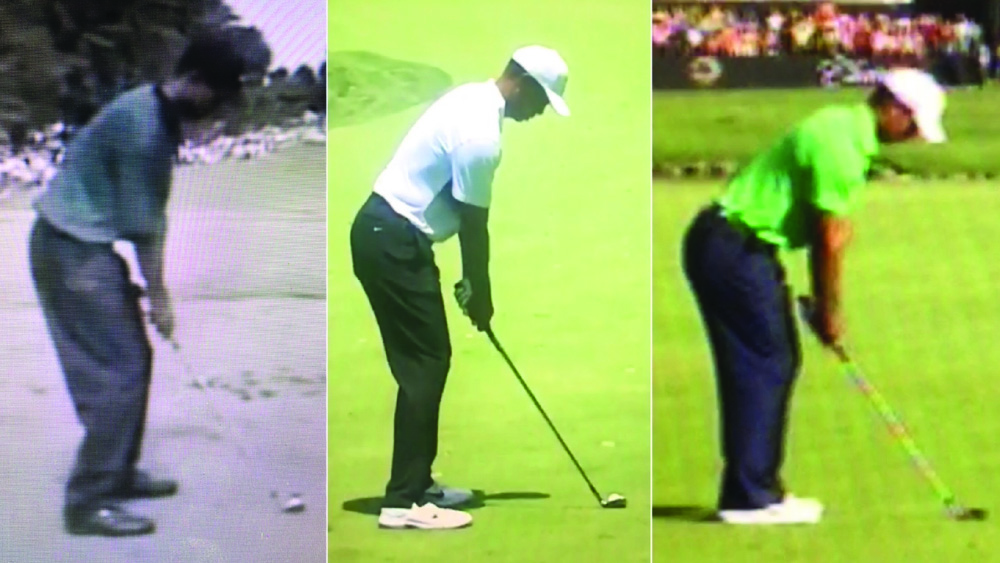
We can also see how setup affected Tiger Woods over his career. In these three images, Tiger’s stances are noticeably different: one is from his early years as a top amateur, the middle one is from his prime around 2005, and the last is from 2011 when he was struggling to find fairways. These setups tell us a lot about how a sound setup can make a big impact on performance.

Another good example is Jason Day. If you compare (above) how he used to set up to how Jack Nicklaus does, you’ll see a big difference in how they are building themselves. Since then, Day has adjusted his setup, which I’m sure helps him avoid back issues.

I’ll end with one of the greatest shots in golf history. On the 72nd hole of the 1988 Masters, Sandy Lyle needed a par to tie. He had a balanced, sound setup—notice the knee and spine flexion and how his torso is perfectly balanced over his legs. This helped him launch his 7-iron just 8 to 10 feet from the hole, and he made the putt to win.

Julio Nutt is a Certified McLean Instructor who has been with the Jim McLean Golf School at the Biltmore in Miami since 2007. With years of experience learning directly from Jim McLean, Julio has built a teaching approach that combines McLean’s techniques with insights from top instructors like Sean Foley and Martin Hall. He is passionate about helping golfers at all levels improve their game through a solid foundation in technique and understanding. Originally from Venezuela, Julio brings a unique perspective and years of international experience to his teaching. For more tips and insights, visit MejorGolf or follow Julio on Instagram at @julionutt.