
Summer temperatures in St. George, Utah, are not ideal for outdoor golf instruction. The desert climate constantly pushes near or past triple digits, leading students to avoid outdoor lessons unless they can book first thing in the morning.
For Brett Chaffey, moving instruction indoors was more than just a way to escape the heat or fit more lessons into a day, it proved to be a major shift in how golfers process feedback and build lasting technical habits.
Chaffey has been coaching indoors full-time for a little over six years, including the last two and a half years at Back Nine Golf in St. George, Utah. He has established a modern instructional model centered on high-definition video analysis, launch monitor metrics and flexible scheduling.
“If you’re working on a student’s golf swing, the technique of their golf swing, I think working indoors is the better way to do it than working on a driving range just because it’s more of a controlled environment for the student,” Chaffey said.
Beating the Climate and Overcoming Outdoor Constraints
Through his coaching with Back Nine Golf, which is an indoor simulation facility open 24 hours, Chaffey is able to better accommodate the busy schedules of his students — in addition to providing a climate-controlled experience.
“Indoor coaching helps avoid the extreme desert heat, which previously restricted outdoor lessons to early mornings or late evenings,” he said. “By working indoors, I can accommodate clients with standard work schedules who prefer lessons later in the day or at night.”
Beyond scheduling flexibility, indoor facilities provide operational stability. Chaffey notes that coaches hesitant about indoor environments often underestimate the value of 24/7 facility access.
“You don’t have to worry about not getting a spot on the range or course due to a tournament or an event, and you are able to offer a controlled environment to focus purely on swing mechanics without the distraction of environmental factors,” he said.
Ability to Integrate Ball Flight Data with Video Analysis
A core advantage of the indoor coaching bay is the combination of ball-flight data and high-speed video analysis. By utilizing launch monitor data — such as club path, face angle, spin rate, and launch angle — alongside the Onform app, Chaffey bridges the gap between feel and real mechanics.
“When students see video side-by-side with launch monitor metrics, it accelerates trust,” Chaffey said. “Learners cannot dispute factual numbers and visual recordings, unlike the more subjective experience of outdoor range sessions.”
Chaffey’s students are often in disbelief the first time they see their swing on video. Being able to see the video playback and talk about the numbers allows Chaffey to bridge the gap of what a student is seeing versus what they are feeling.
To make technical concepts digestible, Chaffey utilizes Onform’s drawing tools to draw swing path lines, knee lines and hip rotation angles directly over videos of his students’ swings. He frequently leverages side-by-side comparisons with professional golfers to provide a gold-standard model for his students to try and emulate.
Chaffey regularly uses PGA Tour player Morgan Hoffman’s swing for his student comparisons.
“Hoffman’s body mechanics and club movement fit the standard checkpoints needed to correct common slice and over-the-top swing flaws without unorthodox movements,” he said.
Chaffey is able to archive hundreds of lessons and thousands of golf swings of his students with Onform, and he’s able to quickly reference past swings with current ones to show progress.
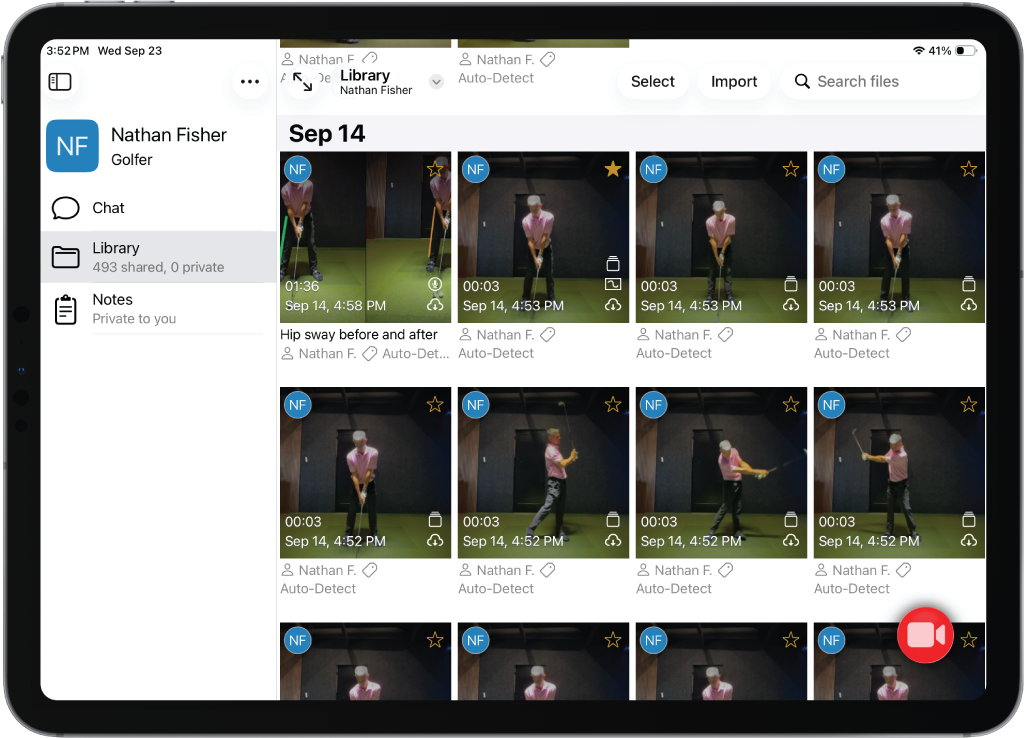
“I’ll go all the way down and show them their first video, and be like, ‘This is where you started,’ because some students six, eight, or 10 months into it will be like, ‘Man, I haven’t changed, I haven’t done anything,’ and I’m like, ‘Wait, let’s look and see.’”
Adapting Practice and Program Structure for Different Age Ranges and Abilities
Chaffey has students as young as four and as old as 88, requiring him to adapt his teaching strategies. With junior golfers, he makes lessons interactive by having them use Onform’s markup tools to draw swing plane lines directly on the iPad.
“They love that,” he said. “Younger students pick up on the technology faster. They like watching themselves on video unlike some of my adult students, and they like the ability to diagnose problems with their golf swing themselves under my guidance.”
When working with adult students who may be intimidated by technology, Chaffey simplifies the presentation, filtering down 16-20 raw metrics so players don’t become overwhelmed.
To ensure genuine improvement, Chaffey avoids one-off quick fixes:
- Baseline Commitment: Every new student starts with a minimum 5-lesson package to establish baselines, evaluate misses, and develop swing mechanics.
- Long-Term Progress: For serious players looking to drop handicap strokes, Chaffey targets approximately 40 sessions per year, transitioning from indoor technique work to on-course strategy.
- Asynchronous Practice: Leveraging Back Nine’s 24/7 membership access, many of his students regularly set up tripods, record independent practice sessions, and send clips via Onform for voice-over review and feedback between formal lessons.
Chaffey advises coaches hesitant about indoor environments that facilities like Back Nine offer 24/7 access without disruptions from tournaments, range reseeding, or weather, creating a controlled, stress-free setting for technique development.
“You don’t have any consequences,” he said. “You’re trying to hit a screen in front of you. All you’re worrying about is just swinging. So it kind of frees you up a little bit more to kind of have at it.”