
Some of the top cricket bowlers in the sport release a leather ball at speeds exceeding 150 km/h (93+ mph). But that explosive power comes at a severe cost.
Young, fast bowlers between the ages of 14 and 23 are among the most injured athletes in global sports, frequently suffering from debilitating lower-back stress fractures.
As a sports physiotherapist and fast-bowling biomechanics coach at Power + Pace in Sydney, Australia, my core focus is bridging the gap between injury rehabilitation, strength and conditioning, and high-performance technical coaching using advanced video analysis and performance technology.
By combining tech tools such as Onform, force plates, wearables and radar guns, my team is able to categorize hundreds of individual bowling profiles to optimize player mechanics, keep young bowlers healthy, and maximize pace.
The Gap Between Injury Prevention and Performance
For decades, sports physios treated fast bowling injuries reactively. Bowlers got hurt, underwent months of rehab, returned to the field, and often succumbed to the same stress fractures all over again.
Early on in my work across elite sports systems, I saw a massive disconnect between understanding the strength and conditioning side, the performance side, and true technical biomechanics.
Rather than simply getting injured players back onto the field to repeat old movement patterns, I shifted my focus toward building stronger, more robust bowling techniques that simultaneously reduce injury risk and maximize velocity.
Why There Are 250 Ways to Bowl Fast
One of the biggest mistakes in bowling coaching — much like pitching in baseball or swings in golf — is forcing every athlete into a single “textbook” movement template.
My team and I profile athletes based on their individual physiology, movement capacity, and neuro-muscular organization rather than their chronological age or a rigid model. Through extensive profiling, we have identified approximately 250 distinct bowling action types based on the following factors:
- Movement Initiation: During the run-up and the transition into the action.
- Action Alignment: Alignment and coordination of limbs, trunk and spine relative to the target.
- Energy Transfer: How forces create a specific sequence through the kinetic chain
- Physical Capacity: Ground contact times, joint angles, and strength metrics.
We try to understand what bowlers should do naturally and why they do it. When I look at video analysis with an athlete, I’m not asking if they look like a textbook model — I’m asking: “what are you doing, why are you doing it, and does that correlate with how your brain wants to talk to your body?”
Inside My Multi-Camera Tech Setup
Because the fast bowling delivery occurs in under 500 milliseconds, the human eye cannot catch the critical mechanical breakdowns that cause injuries or rob a bowler of speed.
I rely on a synchronized multi-camera setup powered by mobile video analysis through Onform to evaluate mechanics frame by frame.
Run-Up & Momentum Tracking
Before reaching the crease, bowlers sprint down a dedicated runway. I use a tethered sprint machine (T-APEX) synchronized with rear and side video cameras to measure run-up velocity, step pacing, and loss of momentum heading into the jump.
The 3-Camera Crease Capture
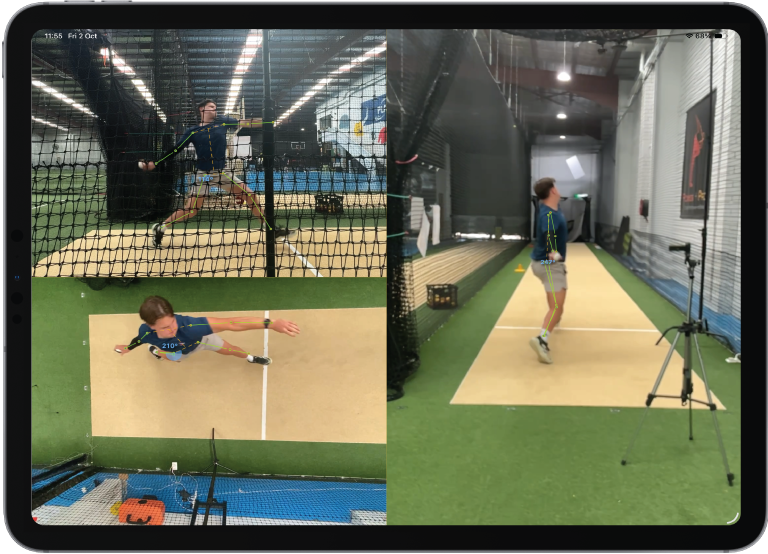
I use a three-camera delivery setup for my athletes, with a fourth camera sometimes added with a head-on view.
- Rear View: Positioned directly behind the bowler to monitor arm path, release alignment, and lateral trunk flexion.
- Side View (5-6 Meter Spread): Captures stride length, knee flexing angles at foot strike, and ground contact duration.
- Overhead View: A mobile camera attached to an overhead rig captures the rotational separation between hips and shoulders in true 3D.
Ultra-High-Speed Seam Tracking
To analyze seam position and ball spin, my team applies high-contrast tape to the four-piece leather ball and records high-frame-rate zoomed footage to observe exactly how the ball exits the fingers.
Real-World Case Study: Transforming Sonny Baker’s Pace
The power of combining video analysis with performance tracking is best illustrated through my work with Sonny Baker, a 23-year-old fast bowler who recently made his international debut for England.
Early in his career, Sonny struggled to translate technical drill improvements into match performance. By recording garage drills and syncing them with game footage using cloud-based video management in Onform, my team and I mapped out a step-by-step biomechanical rebuild.
The result? Clear, verifiable structural changes that helped Sonny bowl consistently at 150 km/h (93+ mph) at the highest level of international cricket.
Bridging ‘Feel vs. Real’ for Diverse Learners
Every coach encounters the disconnect between what an athlete feels they are doing and what is actually happening on camera. In my coaching practice, I see that athlete learning styles vary dramatically:
- Kinesthetically Aware Athletes: Highly tuned to bodily sensation. Video acts primarily as secondary confirmation of what they already felt.
- Visual/Analytical Processors: Require instant video confirmation after every repetition. Without immediate visual feedback, their internal motor sensors can overcomplicate movement patterns.
By managing a library of over 33,000 videos, my team delivers instant side-by-side comparisons via an iPad, allowing bowlers to immediately adjust their next rep.
My Key Advice for Coaches
For coaches looking to introduce video technology and biomechanical tracking into their program, I leave you with one overarching recommendation:
Keep it athlete-centric. What you achieve on video isn’t always the be-all and end-all. Video and data are feedback systems, not directive systems. Use technology to understand the information, rather than being dictated by it

Aaron Lewis is the co-founder and head coach at Power + Pace, a cricket performance and rehabilitation academy located near Sydney, Australia. Aaron is an Australian Physiotherapy Association Sports and Exercise Physiotherapist, exclusively dedicated to cricket fast-bowling rehabilitation, biomechanical analysis, and technical velocity development.