
A lot of the coaching content you’ll find on the Onform blog — and elsewhere across the internet — is focused on how to make you a better coach. While swing analysis, leveraging 3D data, improving coach-athlete communication and other coaching disciplines are important, it’s all meaningless if your business isn’t healthy.
Most coaches get into this industry because of their passion for the game of golf, not to run a business, but you can’t lose sight of the business side of instruction. Below we will highlight business insights from some of the top golf coaches in the game, including how to optimize your business model, how to increase your value to your students, how to reduce churn and create “stickiness” with your students, and how to diversify your services and value streams.
Tip 1: Move from Time-Based Billing to Knowledge-Based Scaling
Golf instruction is still “old school,” in the sense that most business models are built around linear, time-based billing. But charging based on one-hour blocks creates an immediate revenue ceiling because an instructor only has so many hours in a day.
To scale, coaches must shift toward productizing their expertise and getting paid for their knowledge, rather than their physical presence at the range or in the hitting bay.
“It became clear that the coaching business of golf seems to be stuck in the middle ages on how we earn our money,” says Adam Lambe, Co-Founder and Director of The Coach Alliance. “You don’t need to start at 8 a.m. and smash 10 lessons out a day, seven days a week.”
Lambe suggests subscription models, live remote lessons, asynchronous remote lessons and group coaching as options to increase revenue while not increasing (or in some cases, decreasing) your time investment.
For example, Lambe recommends hosting a putting or chipping clinic as a group lesson for beginners to intermediate golfers and charging $50 an hour per person. At each station, you could have a teaching aid with educational materials on how to use them.
“Instead of making just $100 in an hour teaching one student, I’m earning $300 an hour because I have six people paying,” Lambe explained. “And then you could sell products on top of lessons through affiliate deals with manufacturers or sellers of the training aids.”
Tip 2: Overcome the Industry Avoidance of Standard Sales Practices
Hugh Marr, a Master Coach with 20-plus years of experience coaching on professional tours worldwide, recalls a mentor telling him the two most important elements of every golf lesson:
- Don’t let the student leave without rebooking.
- Get paid.
“You would not believe the amount of coaches that are afraid to get paid, afraid to ask for money, who think that it’s pushy to ask them to rebook,” Marr said. “I mean, two of the most simple business practices that exist in every other service industry, for some reason it’s viewed as tasteless.”
Marr also urges coaches to regularly audit their pricing models. While gas and grocery prices continue to rise with inflation, many coaches are still charging what they charged a decade ago.
“Treating golf instruction with the operational discipline of a service or luxury industry is foundational to survival,” Marr said. “When was the last time you increased your lesson fees? Your rates should match inflation and reflect your experience and expertise.”
Tip 3: Expand Your Reach with Remote Coaching
Traditionally, amateur and professional golfers sought out instructors based entirely on who was available in their local geographic area. Today, with social media, digital content, and coaching platforms such as Onform, students can seek out instructors who match their style, personality and other criteria they want in a coach.
“Physical location is no longer a barrier,” says Tony Ruggiero, a Golf Digest Top 50 and Golf Magazine Top 100 teacher and Founder and Director of Instruction at Dewsweepers Golf. “A student can see a coach a few times a year in person and maintain the relationship completely through remote apps.”
Ruggiero uses Onform to remotely coach his students and Dewsweepers Golf instructors throughout the east coast.
“With Onform, distance is irrelevant,” he said. “I can send a student a link, they upload their video, and I’m looking at it before I have my morning cup of coffee.”
Tip 4: Reduce Churn with Strategic Subscription Models
The standard “quick fix” lesson model — like a student wanting to improve a certain aspect of their game before a big golf trip — naturally produces an incredibly high customer churn rate. This practice isn’t sustainable for a successful business.
Marr believes that most instructors operate under the assumption that students are not just looking for a one-off lesson, but how you “sell yourself” to them in those first lessons will determine whether or not they come back.
Transitioning students into long-term monthly subscriptions stabilizes recurring revenue, maps cleaner onto a student’s actual improvement cycle, and flattens out the steep seasonal revenue drops common in northern climates.
Try implementing the following deliberate practice loop with your students:
- Set a goal with your students.
- Form a plan to accomplish said goal.
- Implement focused practice around that plan.
- Provide immediate feedback along the way as the coach.
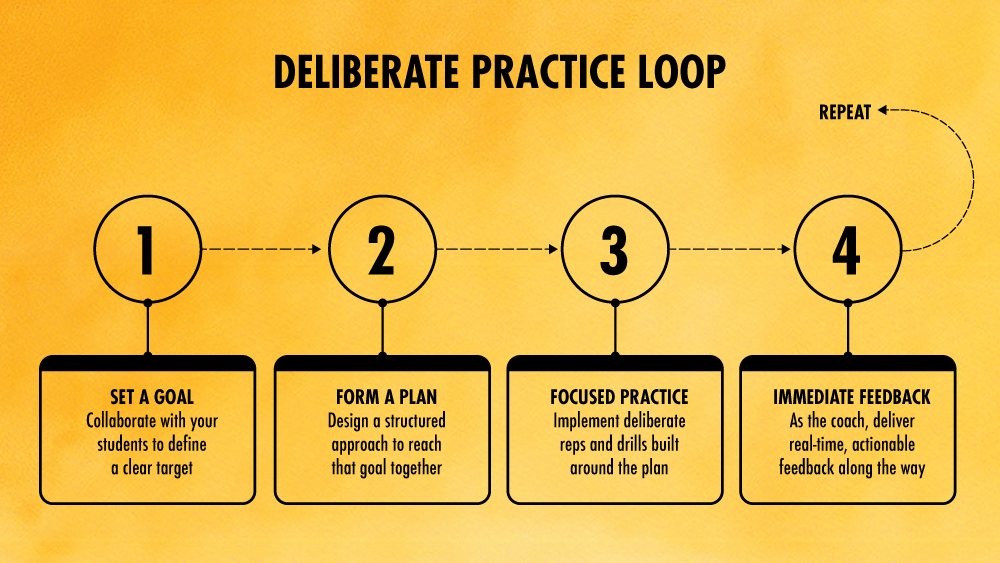
You can establish macro (big) and micro (incremental) goals with your students. This can lower churn by enabling greater engagement and commitment tracked by asynchronous remote check-ins through platforms like Onform. This also lowers the time commitment of coaches while justifying a premium monthly retainer.
Lambe urges coaches to think strategically about how they can package various services and conveniences together into subscription tiers. For example, by bundling a couple hours each month for private coaching sessions, plus the review of the lessons, plus the use of a coaching platform like Onform, plus the practice plans, you have a package that justifies a monthly cost of hundreds per student. Then you can layer in discounts on group lessons and golf trips as upsells to those subscriptions.
“Suddenly, you’ve turned a student whose budget was maybe $150 to $200 a month, and suddenly they’re spending $300 or $400 a month with you, but they’re happier than ever,” Lambe explained.
Tip 5: Diversify Your Business Through Partnerships and Affiliate Marketing
Golf instructors are the de facto primary influencers within their local club or facilities. This social capital can be leveraged into scalable revenue streams that do not require active teaching hours.
Lambe found ways to increase revenue by leveraging his influence through partnerships with luxury brands that pay premium commissions for client referrals.
“I had a partnership with Porsche, the car company,” Lambe explained. “If I was able to bring them a new customer, I was able to get 3% or 4% commission on a new car. Suddenly, I’m using my influence, my knowledge, and my network.”
Lambe also regularly recommends books for his students to read, sending them affiliate links to purchase the reading materials on websites such as Amazon. He also includes affiliate links to training aids in blog articles and email newsletters for additional revenue.
“You have to think outside the box and not sell yourself short on the influence you may have to not only help people with their golf game, but also everything that surrounds the golf game,” Lambe says.