
Many consider multi-discipline competitions the hardest events in track and field. Athletes often are chosen to compete in decathlon and heptathlon because they excel at one or more of the distinct disciplines.
At the Division I collegiate level, athletes who thrived in jumping events such as high jump and pole vault in high school are often selected to compete in multis in college. But many have never competed in the 60-meter hurdles or even picked up a javelin or a shot.
This is where modern-day video analysis comes in. Jackson Schepp, an assistant coach for multi-events and pole vault at North Dakota State University, uses Onform to record and break down the form and mechanics of his athletes.
The instant feedback and “seeing is believing” concept has helped his athletes improve — especially in their weaker disciplines. This progression was a key component of NDSU sweeping The Summit League men’s and women’s Indoor and Outdoor Championships in 2026.
“I really just feel the video communicates way better than words can,” Schepp said. “I have this whole theory that nobody coached a baby to walk. We didn’t use words to learn how to move in the first place.”
Real-Time Feedback, Instant Improvement
Schepp utilizes video to bridge the gap between perceived and actual movement patterns of his athletes. Platforms such as Onform act as a superior instructional tool compared to solely verbal cues for technical disciplines such as pole vault, high jump and throwing events.
“I think every human learns movement through visualisation, like seeing someone do it, trying it, failing, trying, failing, until they get it. Basically repetition until it clicks,” Schepp said. “I don’t have to say words. They don’t have to think through words. They can just look at the video, and see where they’re at.”
While many coaches across sports use Onform for remote coaching or pull up historical archives for side-by-side comparisons to showcase progression, Schepp uses the platform for instantaneous feedback and as a visual teaching tool.
Similar to how coaches in the NFL will review a play on a tablet with a quarterback after a touchdown throw or interception to showcase what went well or what went wrong — Schepp uses Onform to show a shot put athlete that they aren’t getting enough rotation in their throw, or show a high jumper how they are running on the curve into their approach.
“They don’t have all that context of all the thousands of reps that we see every day,” he said. “So it gives them that comparison and they get a better understanding of having a spectrum of movement.”
By utilizing multiple recording angles, slow-motion playback, and ultra zoom capabilities, Schepp is able to show the subtleties of an attempt — successful ones and failures — that verbal cues simply can’t communicate.
Video also allows Schepp to get more granular with his coaching and analysis. A key approach is removing the “morality” of technique, focusing instead on objective observation of what is occurring rather than labeling it simply as “good” or “bad.”
“We ask, ‘what was the takeoff?’ Was it under you? Was it too far out in front? Was it too far behind? Having the understanding of what’s style versus what’s the actual technical piece you’re trying to teach and develop is super important,” he said.
Role-Playing Against Elite Examples
Coaches who use Onform often use side-by-side comparisons of professionals next to their athletes to show the gaps in form and movement.
Schepp takes this a step further, comparing a discipline of one of his multi-sport athletes to a top athlete in the conference or at the Division I level. He then will run “mimic drills,” where his athletes are encouraged to emulate the elite performers in their respective events.
“Probably the most valuable feature is video comparison,” he said. “Contrasting an athlete’s current technique against elite performers or the athlete’s own previous attempts highlights discrepancies.”
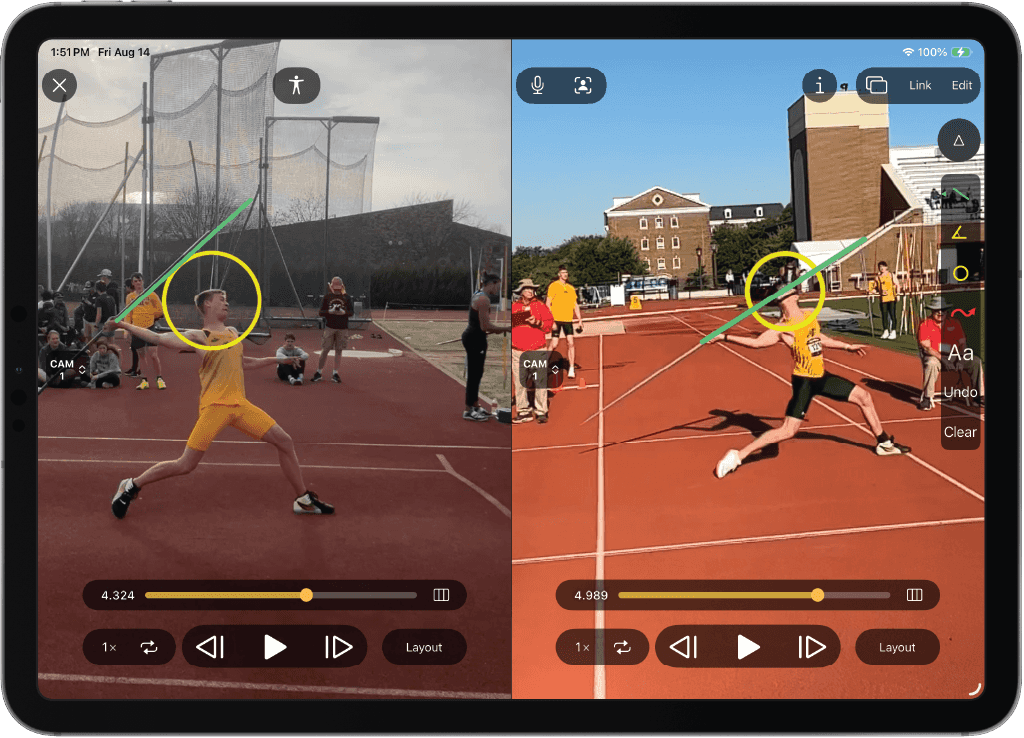
When it comes to setup, Schepp utilizes iPads for both individual feedback and group settings where athletes film each other to maintain a consistent flow of practice. Side views are preferred for approximately 80-85% of feedback, but front and back angles are also important for complex, rotational disciplines such as shot put and discus.
Pole vault is considered the most difficult to capture due to the different phases and the range of depth in the approach — the plant, the take-off, the inversion and the clearance. Most of the time it’s from the side, recording from the left side or right side depending on the athlete’s handedness.
Schepp also likes to get head on angles and directly behind the athlete during an approach.
“If you have the ability, I think it’s very beneficial to get different angles,” he said.
Case Studies of How Video Improved NDSU Athletes
Paul Olson, the NCAA Elite Scholar-Athlete Award winner, came to NDSU with just one year of high school track experience. His specialties were as a jumper and sprinter. He had never picked up a javelin before arriving on NDSU’s campus.
Olson had a personal best in the javelin throw of 38.99 meters his freshman year. By his junior year in 2026, he improved to 60.86 meters.
Senior Zach McGlynn was a 2026 First-Team All-American in the heptathlon and Second-Team All-American in the decathlon. He came to NDSU as a walk-on.
McGlynne’s progression in the pole vault was key to his success. As a freshman, he had a personal best of 4.45 meters, and currently holds a PB of 5.3 meters.
On the women’s side, Yolanda Nabwe set a Liberian national record in the javelin at the 2026 Summit League Outdoor Championship, throwing 46 meters after just throwing 33 her freshman year. She also progressed significantly in the high jump, increasing from 1.42 meters to 1.67 meters.
Finally, Rylee Johnson saw a significant leap in long jump, going from 4.9 meters her freshman year to 5.47 meters as a sophomore.
“Having that visual feedback played a crucial role in the progressions of these athletes,” Schepp said. “I really just feel that video communicates way better than words can.”