
In baseball, a player’s intuition can be their own worst enemy. Hitters are taught to rely heavily on feel, but physical sensation is a shifting baseline that changes every single day.
A hitter might square up a ball with poor mechanics, get a hit, and falsely assume their swing felt great. Conversely, they could execute a fundamentally flawless, highly efficient swing but get a poor result, leading them to believe something is broken.
If you base your adjustments purely on how a swing felt, you are guessing. To truly eliminate the slump, coaches and players must transition from subjective feelings to hard, objective facts.
That is where modern video analysis through platforms such as Onform becomes the ultimate diagnostic tool.
“Video data is half the equation. The player’s internal feedback is the other. Pairing these two elements allows for high-impact, asynchronous video reviews — complete with voiceovers and visual markup — that the player can save to a reference folder and review at midnight or 6:00 a.m.”
The Most Common Hitting Flaws (And How to Fix Them)
When evaluating a hitter for the first time, coaches often look for subtle, complex kinetic chain breakdowns. However, the most destructive flaws are surprisingly universal.
Across almost all skill levels, the two most frequent inefficiencies are:
- Striding too far forward.
- Pushing the contact point too far out in front.
When a hitter lunges forward, they drastically reduce their decision-making window and bleed power. To counteract this, coaches use the “Flamingo Drill” — working extensively on one leg to force the athlete to stay back.
The logic is simple: You cannot shift and lunge onto your front foot if there is nothing to shift and lunge on. By keeping the front foot elevated and remaining stacked over the back leg, the player forces the ball to travel deeper into the zone, gaining valuable fractions of a second to read ball spin and location.
The Best Camera Angles for Evaluating Hitters
To capture these errors, camera placement is critical. While a chest-on view is common, it obscures essential data. It is virtually impossible to accurately judge pitch location (inside versus outside) or swing direction from the side.
The most comprehensive data comes from directly behind the hitter — straight back down the toe line or the batter’s box line. This is what golfers call a “down-the-line” view. From this vantage point, a coach can better analyze:
- The path of the barrel of the bat as it enters the hitting zone.
- Ball flight and direction off the bat.
- Release point of the pitcher relative to the hitter’s contact point.
While baseball environments don’t always allow for perfect camera positioning due to nets, screens, or fences, getting as close to that true down-the-line angle as possible yields the highest-quality diagnostic data.
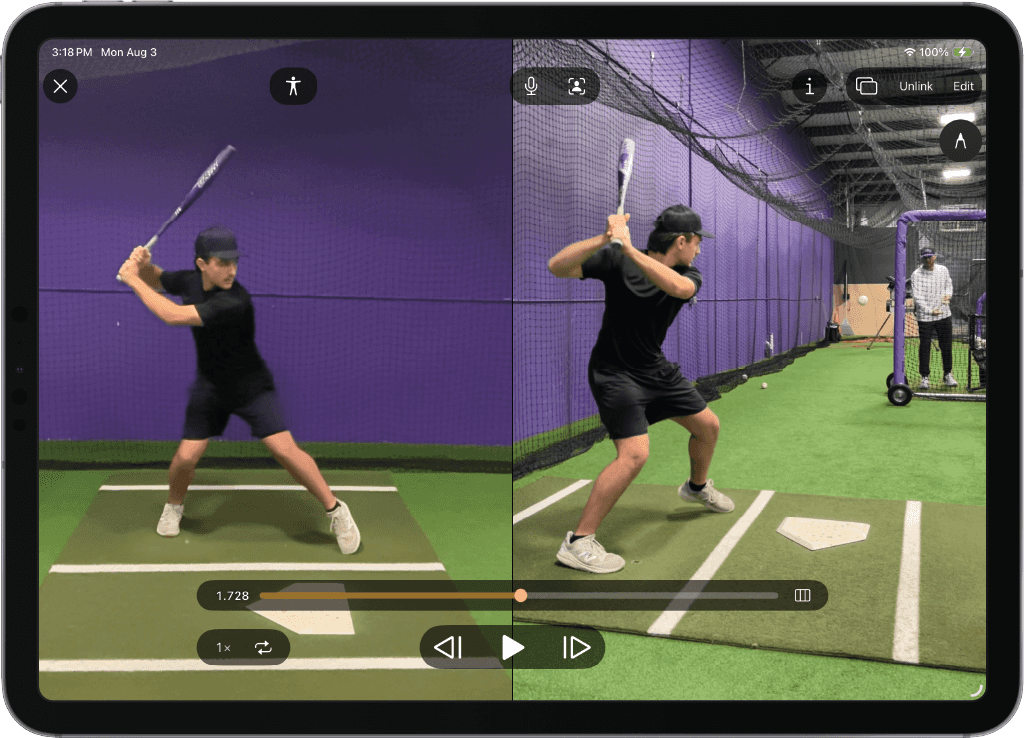
Scaling Expertise Through Remote Coaching
The traditional constraints of onsite instruction are fading. High school and elite travel coaches are managing massive rosters, often leaving them with zero time to get in the weeds with individual swing mechanics.
Furthermore, once a hitter crosses a certain competitive threshold, they require hyper-specialized attention that a general team manager often cannot provide.
Remote coaching bridges this gap. It has allowed me to manage upwards of 150 players globally.
However, remote coaching only works if there is a strict, two-way system of accountability. I have a strict rule for my remote instruction: No feedback, no review.
Before diagnosing a swing on an app like Onform, a coach needs to know the context behind the video. Coaches must be familiar with the following:
- What was the hitter thinking?
- What did they feel?
- What was the ball flight?
Video data is half the equation. The player’s internal feedback is the other. Pairing these two elements allows for high-impact, asynchronous video reviews — complete with voiceovers and visual markup — that the player can save to a reference folder and review at midnight or 6:00 a.m.
The Elite Adjustment: Pros vs. Youth Hitters
There is a stark contrast when utilizing video across different age brackets. Working with youth or high school athletes often results in massive, highly visible mechanical transformations.
Because their bodies and habits are still incredibly moldable, a simple video adjustment can completely change their trajectory.
At the pro or Major League level, the job shifts entirely. You aren’t molding a new body or rebuilding a swing from scratch.
Instead, the modifications are exceptionally minute and incremental. It might be a one-degree adjustment to a slot or a micro-correction to a pivot that the untrained eye would never notice.
By building a digital reference library of elite “movers” such as Mike Trout, Mookie Betts, or Freddie Freeman, coaches can easily use overlay features to show a player exactly how their micro-movements diverge from the gold standard.
In a game decided by millimeters, having a precise, visual blueprint isn’t just an advantage — it’s a requirement.
About Trey: Trey Hannam is a professional hitting coach who specializes in elite player development across baseball and softball. In a rapid two-year span, Hannam ascended from coaching high school baseball to Division I college baseball, ultimately transitioning to the professional ranks as a minor league hitting coach within the New York Mets organization. He now owns a private training facility in Illinois and remotely trains hundreds of players and coaches online.