
Incorporating technology into golf instruction is more approachable and affordable than ever.
Capturing 3D biometric data is no longer reserved for the sport’s elite players. Restrictive, electromagnetic setups or bulky marker-based systems with hefty price tags are no longer necessary to collect valuable and accurate measurements of what a student’s body is doing when they swing a golf club.
Using Onform, golf instructors can easily record, review and analyze their students using markerless 3D tracking technology. Almost instantly, coaches can view advanced biomechanical sequencing and 3D visualizations as well as slow-motion playback and side-by-side comparisons of swings.
For veteran instructors like Ken Racca, a New York-based coach pushing a high-volume of lessons each year, this shift isn’t just a minor technical upgrade; it’s a complete revolution in how the game is taught.
“You can actually see your students moving through time and space and get those sequences in the palm of your hand, which is mind-boggling to me,” Racca says. “I didn’t have to spend $35,000 to get a 3D system. I can do it on my iPhone.”

Mastering the Universal Sequence Across All Body Types
The kinematic sequence is the signature fingerprint of the world’s best ball-strikers. It measures the precise, millisecond-by-millisecond chain reaction where energy transfers from the pelvis, through the torso, into the arms, and finally whips through the clubhead.
One of the most compelling aspects of the kinematic sequence is its universality. Golfers come in every shape and size, but at the moment of impact, the physics of an efficient swing remain identical. Whether watching a pristine modern swing or an unorthodox amateur profile, the sequence is the ultimate equalizer.
“All of these guys are able to maximize their efficiency in their swing regardless of their body type because they have a mastery of the kinematic sequence,” Racca notes of professionals. “So it doesn’t matter if you’re a big guy and a dad bod. It doesn’t matter if you’re a little guy. They all use the sequence to maximize their output.”
Historically, coaches had to rely purely on video playback to emulate these movements, drawing lines and analyzing static angles. But video can be deceptive. While visual feedback is excellent for showing what a body position looks like, it struggles to capture the precise timing of when specific muscle groups fire and decelerate.
This deep diagnostic layer is especially vital given the rapid evolution of the modern golf student. Armed with algorithmic feeds, amateurs are arriving at the lesson tee with unprecedented — if sometimes scattered — technical knowledge.
“Today’s students are far more educated about the golf swing because of the availability of information,” Racca says. “All the YouTube videos and articles and AI and ChatGPT — I have students that come in and quote that stuff all the time and they’re like, ‘How do I know if I’m doing that when I swing?’”
Case Study: Improving Clubhead Speed in 74-Year-Old Golfer
Relying purely on the naked eye or standard video often leaves coaches diagnosing symptoms rather than the root cause of the swing flaw. Racca recently put this to the test with a 74-year-old student, who was struggling with severe mobility issues.
The student’s 7-iron clubhead speed sat at a respectable 70 mph, but his driver maxed out at an inefficient 76 mph. This small gap signaled a massive breakdown in power transfer.
He spent years trying to fix a visible “casting” characteristic where he released his wrists too early, believing he had finally cured it. Traditional video analysis didn’t clearly reveal why the power gap remained, but a quick mobile kinematic capture exposed the truth.
“I could actually show him how much his arms were decelerating through impact as compared to the rest of the peaks in the kinematic sequence,” Racca says. “I was able to actually say, ‘Hey, look, these peaks should all be kind of lined up and proportionate, and this one is going the opposite way of everything else, and that’s why you have no driver speed.’”
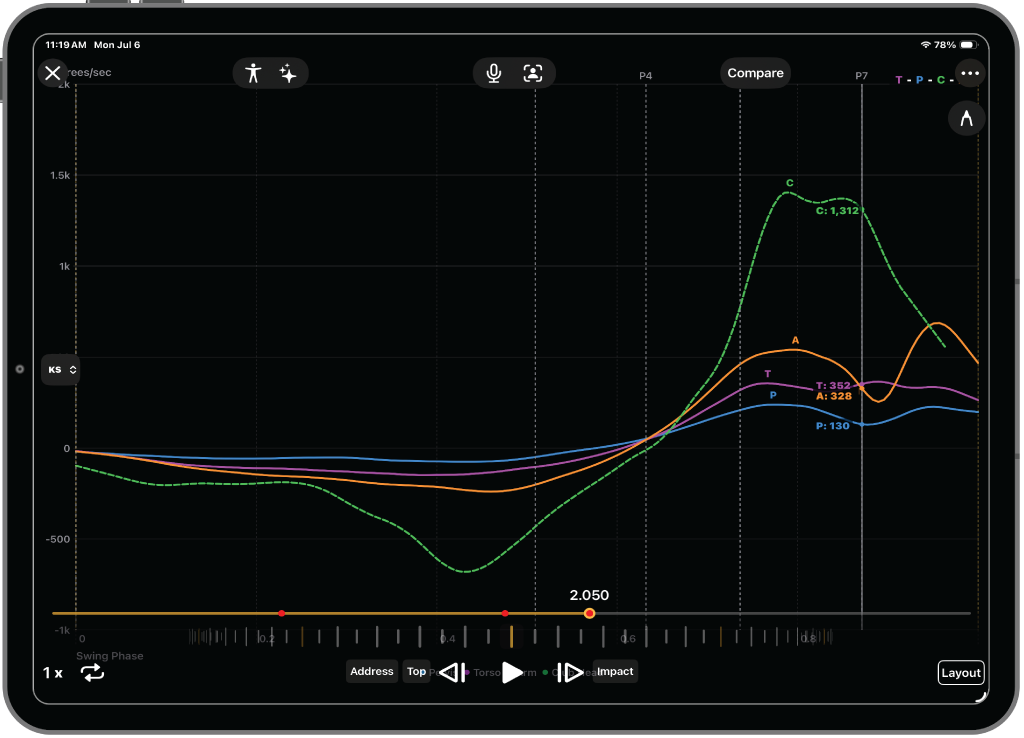
Seeing the exact graphical evidence of the energy leak provided an immediate breakthrough. It allowed Racca to re-prioritize the lesson plan and show the student exactly how his body needed to retain lag to maximize his physical output.
“There is still stuff that people do in their swing that cannot be identified with the naked eye,” he said. “You just can’t do it. Anybody that’s teaching without data is guessing, and it’s all there is to it.”
Instead of fearing the influx of data, Racca urges coaches who have yet to fully embrace 3D visualizations in their coaching to lean into it, especially with mobile-friendly, approachable solutions like what Onform offers.
“I would tell coaches who are afraid to start looking at the data to jump in feet first. Read as much as you can, consult with the experts in the field, because it will make you a better teacher,” Racca said. “The best doctors in the world have access to the best technology, and now we have that technology.”